Showing posts with label China. Show all posts

Thursday, April 17, 2025

Reign of Assassins (Jianyu Jianghu)

 The Dark Stone gang, a powerful group of assassins, is after the remains of an the ancient Buddhist monk Bodhi in the belief that the corpse would give its bearer fancy martial arts powers. The bastards kill the possessor of the corpse and his son in cold blood, but one of the assassins - the beautiful Xi Yu (Kelly Lin) - out-assholes them all and flees with the top half of the corpse.

 While on the lam, she meets a roving monk called Wisdom. It's unclear whether the relationship is romantic (Wisdom does eventually confess to have a crush), but they spend three months training before Xi Yu kills him during a lesson when she loses her cool. Distraught, she takes his dying advice and decides to honour him by never killing anyone else.

 And so she travels to a doctor who operates (heh) out of a houseboat, and asks him to give her a new face so she can start a new life. I should note plastic surgery in Jianghu - the martial arts world - involves poison, flesh-eating insects working from the inside out, and gold thread; Just one more reason why we love wuxia.


 And thus Xi Yu transforms into Zeng Jing (Michelle Yeoh) and starts a new civilian life as a cloth merchant; She soon meets Ah-sheng (Jung Woo-sung), a humble courier, and they marry.
 Their placid life is briefly interrupted when they are both caught in a bank robbery; When it turns ugly she single-handedly foils the kung-fu-powered robbers and is outed as a badass, Ah-sheng's reaction? 'I don't care if you were a brigand, now you're my wife.' Loving and slightly demeaning, but I think that's just the translation - it's supposed to be romantic.

 The attack at the bank draws the attention of the rest of the Black Stone Gang, who have replaced Xi Yu with Turquoise (the recently late Barbie Hsu). The leader, The Wheel King (Wang Xueqi) performs something I always enjoy: Kung-fu forensics, and uses it to determine that the person who defeated the robbers could be no one but Xi Yu.
 The assassins face off again, and the stray swordswoman is coerced to retrieve both halves of the ancient monk's body for team evil. Assassins gonna reign, or something. Which of course leads to a few surprises, a lot of fights, and melodrama to spare.

 The script, by main director Su Chao-pin, is fairly sloppy; there are many contrivances, unnecessary scenes, and the all-important MacGuffin which drives the action is oddly relegated to the background and eventually forgotten.
 But the thrust of the story is powerful, and as forward momentum accumulates, disparate elements that had been previously established come together in highly satisfying/entertaining ways. For all the script's problems, it can be pretty clever, and its entry-level use of Buddhist philosophy can even be seen as wisdom, if you look at it from the appropriate angle and with enough goodwill.
 The story is also full of odd, cool touches and excellent acting. Many characters, including the villains, get splashes of backstory that give them a lot of colour, and there's a sense of humour about the movie that makes it very likeable. It's a good one.

 There are plenty of interesting martial arts on display; Things like Xi Yu fighting with a thin, flexible blade that bends to strike targets from an unexpected angle (kind of like the way flails were supposed to curve over shields), or a magician (Leon Dai) who uses flaming swords.
 The problem is that the director does not shoot the action cleanly; The edits are short, and the camera often too close to the actors. It's not bad, exactly: The fights are easy enough to read, and they clearly prioritize making the cast look good and showcasing cool moments; In that, the director succeeds. But the scenes don't flow well, and I was often frustrated at the choppy quality of the combat as the edits jumped from one beat to the next, often completely changing angles. This break with Hong Kong tradition is especially galling because they had John Woo in an advisory capacity for enough time that he's billed as a co-director.

 And yet... I can't be disappointed with a movie that begins with a single assassin fighting and killing a whole kung-fu family, starting with their very young son. In self-defense, no less!

 Elsewhere the film looks very good. The cinematography (Wikipedia lists five cinematographers) is good, and the editing style, while it takes some getting used to, gives it a sort of elegant, flowing quality.
 This is one of the rare wuxia movies where the story far outshines the action. The cast is gifted, the wire-work is great, and the choreographies are excellent and have plenty of cool moves... it's a shame that we can't enjoy all of that properly. Other than that and some storytelling glitches, it's an excellent wuxia tale: enthralling, often funny, and surprisingly sweet.

Friday, March 07, 2025

Blind War (Mang zhan)

 For all its many, many faults, you can't blame Blind War for not being entertaining. And it's never more entertaining than during its first ten minutes: a courtroom-set symphony of gunfire that includes a priest opening fire on a judge, a clown getting dramatically mowed down by the police, and the pretty defense lawyer stabbing a policeman. There's a gatling gun, a flying... helium? canister, multiple explosions and a small army of policemen and criminals going at it within the building and in the street outside.
 The action is.... well, it's more about quantity than quality; There are some cool moves, but the choreography is not that complex, it's not cut well, and the CGI explosions and blood effects are pretty bad. It is pretty fun, though.

 During that fracas the heroic captain Dong Gu (Andy On) manages to put down the main villain, but it comes with two consequences (or CONSEQUENCES, as the Baba Yaga would say, nodding sagely): First, he's permanently blinded by a close-range flashbang detonation. And second, he earns the mortal enmity of a psychotic woman (Yang Xing) when he kills her lover.


 This movie plays like a deadpan spoof of eighties action movies, starting with the fact that after all his heroics Dong Gu gets blamed of incompetence by his by-the-book boss and run out of the police force. He's understandably miffed, and has trouble adapting to his new sightless civilian life; But with the help of his teen-aged daughter, he learns that his preternatural hearing (signalled by his twitching ears, a visual device I never stopped finding hilarious) is actually a pretty decent substitute for eyesight. This is way more Daredevil than Zatoichi or Blind Fury.

 Since his daughter is all he has to live for, she of course gets abducted during a trip abroad. But, get this: she gets abducted by same crime family that was on trial in that initial shootout. And it's all happenstance! They just run a human trafficking ring and she was available (in the backstage of a prestigious classical music concert - you know, the type of place lowlife thugs would normally haunt). The script (by Laogou Lin) is... well, let's just be charitable and say its sole concern is to facilitate action scenes.

 When Dong Gu goes on a rampage to recover his daughter, the psycho who has it out for him sees him on TV, breaks out of prison, murders a police woman and takes her place to get close to him. "I'll get close to my enemy and use him to get revenge on the old bosses who raped me" is a novel angle for a villain, but based on the evidence here I doubt it'll catch on.
 From there the duo start working their way up the crime ladder to get to the head of the trafficking ring.

 Oh, and there are extremely ill-advised attempts at broad comedy, mostly thanks to a hapless local cop. They are painful to watch, and I say this as someone who's somewhat inured to this sort of sort of thing thanks to a lifetime of watching martial arts films. At one point they have the guy use the body of an innocent murdered woman as a (terrible) punchline, a rotten cherry on top of the shit pile.

 Blind War is an incredibly fucking stupid movie. It's haphazardly put together (I don't normally notice continuity errors, but I saw quite a few here) and poorly conceptualized. Andy On is fine as the protagonist, but his fellow cast members have a huge appetite for scenery; It's hard to fault them for bad acting when excess seems to be their goal, but it still comes off as a little cringe-worthy.
 And speaking of excess, Director Suiqiang Huo works overtime to make every single scene as epic as he can, with the result that the film becomes a extremely unwieldy. He employs speed ramping, slow motion, arc shots... it really does feel like the spoof of a heightened action movie, especially when the cameras are orbiting two people while they have a relatively non-important conversation as if it was an epic revelation. The music follows suit, and is painfully intrusive. Especially during the 'comedy' bits.

 So it's a good thing that the film's got a lot of action; It's not, as mentioned above, great action, but it's frequent, loud and pleasingly excessive. It does not compare well at all to movies from the 87eleven team or (the more direct comparison) the Hong Kong action epics from the 80s and 90s, but taken as its own thing - especially when considering it seems to be a relatively low-budget title - it's... all right. Consider this a very reticent recommendation, but please don't hold me responsible for any brain damage.

Sunday, December 15, 2024

The Final Master (Shi fu)

 Chen Shi (Liao Fan), an older Wing Chun master, arrives in Tianjin to establish a martial arts school. This means, of course, that he must defeat the masters of eight of the nineteen established dojos in the city first. Martial artists have the best bureaucracy.

 Because this is a movie written and directed by the great Haofeng Xu, though, things are rather more complicated than that. After arriving in town, Chen first meets with Zheng (Chin Shih-chieh), a local grandmaster. After duly being impressed by his skills, Zheng informs him of several wrinkles in his plans: As a foreigner, Chen can't just go around kicking everyone's ass - he'd be disqualified even if he won. So he must take on a local disciple to do it in his stead. The catch? After winning, his disciple must fight a duel with a local grandmaster, and will be banished from town no matter what the result is so the local establishment can save face.
 Zheng is pretty sure he will be the one that will be called on to duel the disciple, so he asks Chen to take him on as a secret second apprentice, and teach him everything he knows so that he runs no chance of losing the duel.


 All this is fairly simple, as far as the arcane vagaries of honor and traditions go, but don't worry, there are plenty of byzantine twists to keep things confusing.
 To keep the heat off him, Chen pretends to be a lowly commoner, and after a local waitress (Song Jia) gives him a little lip, he takes her on as his wife to help keep appearances. Chen soon finds Geng (Song Yang, Judge Archer himself), a young, uncouth coolie who turns out to be a prodigy, and starts training him in the ways of Wing Chun even though he knows that he's in it to try and steal his wife. And once Geng starts methodically trouncing all local champions, he runs afoul of Master Zou (Jiang Wenli), a delightfully evil woman who runs the city's dojos as if they were a cartel, and Lin Xiwen (Huang Jue), a ruthless colonel and a an old student of Zheng who's trying to bring the martial arts academies under the heel of the military. This is when Chen's devious plan becomes a little bit clearer.

 As with Xu's previous Judge Archer, the film basically drops you in the deep end and slowly gives you just enough information to put things together. It's hard going at times; Some of it is due to cultural remove, but now I've read a couple of translated Chinese reviews that seem similarly bewildered, I don't feel as bad. His script pays special attention to how honour and appearances bind the characters, which ironically leads them to take actions that are... less than honourable, and certainly run counter to their desires.
 It's a rich, confusing tapestry that's very rewarding to work out, but leaves the plot pretty hard to follow; I was lucky in that I watched this with my wife, who's watched a lot less Wuxia than I have, so I had to pause and try to explain what was going on a few times - these conversations and breathing space helped me work things out as I went along.

 She ended up liking it a lot, even if she gave up on fully following the plot at some point. That is largely because the major story beats are solid and dramatic, and also because the script keeps a light touch, with a lot of surprising warmth for its fully fleshed-out characters, a wry sense of humour, tight editing, some incredible visual storytelling, and... of course, a lot of excellent, varied fights.
 Xu's choreographies are quick, precise, and utterly badass - you often get the feeling that the result has been decided beforehand in the opponent's heads. This leads to an astonishing running final battle, where instead of having a protracted showoff between a handful of opponents, a single master faces a whole city's worth of martial artists in a series of minimalistic duels. It's exhilarating.

 The fights also underscore character moments, of course - there's a wonderful scene where Chen bares his soul to his wife while fending off a crowd of angry extras with a bamboo pole, daintily sitting with her in a bench, and the aforementioned final battle is both fuelled by a suitably tragic development and marks a strong character development.

 It looks beautiful, the acting is excellent, and like all of the Haofeng Xu-related movies I've seen so far it feels like there's a lot of thought and care put behind it - strong themes, wonderful characters, and a lot of humanity contortioned into strange shapes by rigid social structures and tradition. The way the plot keeps us at a distance holds it off from greatness - I'd recommend Judge Archer over this one - but it's still well worth it. 

 Sadly it's a bit of a pain to get access to Xu's other movies around these parts: his latest (100 Yards) remains without a UK release date, The Hidden Sword seems to have been completely annulled by Chinese censors for not toeing the party line, and I can only find his first (The Sword Identity) as an overpriced DVD. I'll keep at it.

Saturday, September 21, 2024

Shanghai

 Shanghai has a fascinating history. A focal point for the opium wars, control over it was strong-armed from the Chinese by foreign powers during the second half of the eighteenth century - the British, mostly, at the beginning, but other countries with imperialist designs (USA, France, Japan) soon joined in and basically set up wholly international suburbs around the city. While the city was nominally controlled by the Chinese, it was a sort of international plaything until it was invaded by the Japanese during the second world war.

 A political spy thriller set there just before the US joined WW2 is an incredible pitch, seeing as how both the Germans and the Japanese both had a presence in the city. But Shanghai, the movie, had a seriously troubled production; Permits to shoot on-location were revoked by the Chinese after pre-production had started. This forced the shoot to move to Thailand and the UK, further investors had to be brought in to cover ballooning costs, and let's not forget that this is a mainline Weinstein company production; The full extent of Harvey's sins was yet to be known, but they were still a legendarily meddlesome company. The finished film, when it was finally widely released seven years after completion, is a bit of a mess.


 Paul Soames (John Cusack) is a jaded, worldly spy in the Ian Fleming mould, sent to Shanghai to bring in a rogue spy acquaintance (Jeffrey Dean Morgan) at the behest of their handler (David Morse). When the spy turns up dead, Soames dives into the city's underworld to try to avenge his friend, and discovers that he was following up on some troubling information unearthed by an opium-addicted informant with ties to the head of local Japanese intelligence (Ken Watanabe).
 While all that's going on, he also tangles himself in the business of a local Triad boss (Chow Yun-fat) and his beautiful wife (Gong Li).
 
 The way things tie up is less than satisfactory, with the characters crossing paths in extremely contrived ways (Soames seems to luck into many of his major findings), desultory 'action' moments that drop Soames into a shootout solely to give the film some excitement, logic be damned, and a deeply suspect final act that feels completely at odds with the rest of the film's tone and even its genre. I've liked other scripts by writer Hossein Amini but this one, whether by design or compromise, is not one of his best.
 Pulpy noir and wartime movie references are thick; There's a lot of The Third Man and more than a little Casablanca in this movie's DNA. But director Mikael Håfström loads the movie with stylistic signifiers (An assassin shooting someone only shown by his shadow, Dutch angles, overwrought voiceover) that seem come off less as a homage than tacky.
 It's a lush, often handsome, clearly expensive production that nonetheless is made to feel weirdly low-rent by things like an over-reliance on TV-movie-style captions for the locations, bad editing, some desultory film-making, and an overuse of its claustrophobic exterior sets. This last one is forgivable, given the film's production troubles and how good the sets are; Production designer Jim Clay  pulled off an admirable job, as did cinematographer Benoit Delhomme, who manages to achieve some beautifully atmospheric shots (a shipspotting diversion is a highlight).

 The main problem, though, is the characters. The protagonist in particular is a gaping void at the story's heart, a cypher who uses Bondian nonchalance to mask a lack of characterization. Cusack is a good actor who's really good at putting on a blank expression, and that talent gets a huge workout in this movie. He manages to imbue Soames with a little of his fidgety, nervy energy and some intelligence, but as written the character just doesn't seem to have much of an inner life, however  much the glib voiceover narration may protest.
 And the extremely stacked international cast barely gets to make an impression despite involving some of the biggest stars outside of Hollywood. It's all surface-level; Watanabe gets to show off his wounded dignity, Chow Yun-fat his charisma and poise (even if his one action scene is deeply shitty), and Gong Li's femme fatale is mostly there to... well, look beautiful in glamorous dresses, her character oddly inert despite being deeply enmeshed (in oblique ways) in the plot.

 It's not terrible film, per se, just stilted, staid and disappointingly compromised. A huge waste of an incredible setting and premise, a great cast, and some incredible sets. Ces't le vie.

Thursday, May 23, 2024

The Wild Goose Lake (Nanfang chezhan de juhui)

 A series of escalating petty rivalries within a motorbike-stealing cartel result in Zhou Zenong (Hu Ge) shooting a cop to death. The police mobilize en masse and track him down to Wild Goose Lake, a remote lakeside community where crime runs rampant.
 When the police offer 300000 yuan to anyone who turns Zhou in, he hatches a plan with a couple of close associates to be "handed in" for the reward money - he's got no illusions that the police (which the movie frames in parallel with the criminals several times) will let him live, so he might as well leave his estranged wife some money after he's gone. But because everyone involved has a criminal record, they have to enlist the help of Liu Aiai (Gwei Lun-mei), a 'bathing beauty' - a sex worker who makes a living from lakeside tourists to act as the informant.
 Meanwhile, the asshole who stirred the shit that got Zhou into the whole sorry mess is still around, with eyes on the reward as well. As for everyone else, that amount of money might give people ideas... maybe shift some loyalties.


 The plot is loose, even a little disjointed, and it leaves a lot open for the viewer to interpret. Writer/director Diao Yinan doesn't really neglect the twisty, pulpy plot, nor the expected lurid action. But his attention wanders easily, and the meticulously composed scenes often follow its characters while they go on with their lives without doing anything that might impact the story - if it wasn't so carefully crafted, it'd look heavily improvised.

 It's wryly funny as well - there aren't any real jokes in the script, but Yinan has a real appreciation for the ridiculous. The most over the top example is an unorthodox (and very bloody) use Zhou finds for an umbrella, but there are a few minor sight gags, humorous (at least to me) abrupt cuts and surreal tableaus. Elsewhere the script bogs down (in an enjoyable way) to show, say, some of the finer points of motorcycle stealing (in a scene that reminded me, not for the last time in the movie, of Emily the Criminal), or an improvised disco night where the dancers, for lack of a light-up floor, wear light-up shoes.

 The film is structured as a series of flashbacks and flash-forwards as the various characters and the police circle around each other warily. There's next to no exposition, and none of the main characters are very expressive; You're expected to keep up with all the various factions (or not).
 This complexity does give the film a jittery, paranoid vibe. The suspense tips over into violence several times over; Short bursts only (don't expect complicated choreographies or extended shootouts), but what's there is enjoyable and doesn't shy away from getting a little silly.
 More than anything else, it's an exercise in mood-setting, with almost every languid, morose scene dripping with neo-noir atmosphere (cinematographer: Dong Jinsong).

 I'm not that convinced of its substance, but with this much style, it's a moot point. It requires some patience, but I liked it a lot.

Sunday, February 18, 2024

Judge Archer (Jian shi liu bai yuan)

 China, 1917. Martial artists are running around the country wreaking havoc, as they usually do - either as soldiers serving many clashing warlords, or at martial arts schools. And as we know from countless martial arts movies over the years, martial arts schools aren't any better, always challenging, stealing sacred objects from, or insulting each other.

 Somewhere in the countryside, a man (Yang Song) traumatized after witnessing an atrocity is given a new lease on life by the local monks - they they allow him to drop his previous life and run out into the word cleansed; The first words he hears, they tell him, will be his new name and identity.
 As it happens, those first words are "Judge Archer!", shouted in a forest after some sort of scuffle. Our protagonist finds a wounded old man, who asks his name. When he responds "Judge Archer", the old man tells him that's his name too, and decides to take him under his wing.

 Judge Archers are, as the opening blurb informed us, the people who keep all the martial arts schools in line. Cut to six years later, and the new Judge is now a powerful martial artist; We get to see him in action for a while (he can perform his job even while blind drunk) until the plot kicks in.

 That plot involves Erdong (Yenny Martin), a femme fatale who convinces Judge to kill an old master (Chenghui Yu) who's thrown in with a powerful warlord. Judge (is it ok if I use his first name?) proves he's not being seduced into doing it by literally fighting off her advances in the bedchamber (an amazing and dryly funny fight where the main weapons end up being a length of string, a pair of knives and a chair), and then agrees to her request anyways.
 (And if that last run-on sentence doesn't sell you on the movie, I don't know what to tell you.)

 Things end up being even more complicated than they seem at first (which is plenty complicated) when a beautiful opera singer (Chengyuan Li) keeps interrupting Judge's attempts on the old man's life until he falls in love with her.

 It's a confusing, frustratingly obtuse story that keeps everybody's motivations cryptic. I'm used to just rolling with Wuxia storylines without fully understanding them, but it's especially frustrating here because you get the feeling that there's a well thought-out story full of interesting themes, sitting tantalizingly half-out of reach. It does make sense, mostly, by the end, but there's plenty of bewildering choices, hindered no doubt by cultural distance.

 On the other hand, the movie looks absolutely sumptuous. Director Xu Haofeng has an incredible eye for visuals and tying scenes together in a very compelling way; He also writes, edits and does all the choreography, which is a really impressive list of credits given how well it's all done. The art direction (by Yong Xie) and cinematography (by Tony Wang) are beautiful, and the wardrobe (by Tingting Liang) looks amazing. The film easily earns a ton of goodwill by virtue of just how good it looks and sounds (the music, by Wei An and Fan Wang, is also fantastic).
 And the acting is good. Judge Archer is a damaged weirdo prone to strange pauses, but he's a convincing, very charismatic damaged weirdo. Kuang is a great villain, believably capable and equally likeable, and both of the women are very good as well, although their roles are the most inscrutable.

 It's a thoughtful film full of quiet moments, punctuated by frequent and very cool, very varied fights. There's a series of close-up duels which have people sitting on benches, right on front of each other with their knees almost touching, relying a lot on elbows and the insides of the forearms. Other fights use the aforementioned piece of string, arrows wielded as wands, and pole fights that turn into spear fights when the combatants sharpen the tips by tapping them on a hard object. A lot of attention is paid to footwork, which is something I adore in these movies.
 All great stuff, much less flamboyant than most wuxia but still a tiny bit heightened and very imaginative.

 Set against the rise of the Chinese republic and the ensuing wane of martial arts ("there won't be another Judge Archer", someone says), the story and its themes are quietly affecting- especially when we learn of the fate of the Judge's sister, the catalyst that set the whole story into motion, and compare them to see how their lives diverged.
 Xu Haofeng is serious about all this stuff: he's a researcher into martial arts and its role in history, a well-known novelist in China, probably most famous here in the west for being one of the writers behind Kar-Wai Wong's The Grandmaster. He's appeared once in this blog already, as the writer of the novel Monk Comes Down the Mountain is based off; given just how good Judge Archer is, he will absolutely appear again.

Monday, December 18, 2023

Meg 2: The Trench

 The Meg was a movie with very, very few redeeming qualities: It wasted a fun premise on hoary clichés, unexciting and generic action, and way too much waffling with its corny, boring as fuck characters. It seemed to expect us to care about a bunch of shitty melodrama, while failing to deliver even close to the amount of madness needed to make it palatable.

 Director Ben Wheatley (in full anonymous studio director mode) course corrects admirably for the sequel. This movie has a lot of problems, but embracing its ridiculous sense of excess is not one of them. It populates its almost two hours with silly developments, punchy deaths, and not just shark attacks but some sort of crocodile dinosaur monsters and a giant octopus. Quantity over quality, absolutely, but in owning that it's a dumb monster movie and committing to it with enthusiasm, it makes its plot holes, continuity errors, laughably shallow characters and dodgy CGI entirely forgivable.

 After the events of the first movie, Jonas Taylor (Jason Statham) has turned into some sort of a 'green James Bond', as his friends describe him while debating just how awesome he is. That only factors into the first scene and never really matters again, which is par for the course for this movie's script (by Jon & Erich Hoeber and Dean Georgaris - the same team who did the first one). It's fine; it gives Statham a decent fight scene, at least.

 The movie gets going properly after some table setting, when Jonas and suave scientist Jiuming (the great Wu Jing, who criminally doesn't get a single fight of his own) mount an expedition to the trench where The Meg originally came from: a hidden, mysterious ecosystem blocked off by a thermocline (a barrier of cold water). They take along a few characters to act as redshirts (these movies are firm believers in plot armor), and get a stowaway in Meiying (Sophia Cai), Jonas's teen stepdaughter.

 Once in the trench, the crew find an illicit mining operation and sabotage gets them stranded in the ocean floor From there it's a series of action scenes pretty much all the way to the finish line - fighting against various underwater beasties, then a host of evil mercenaries protecting the mining operation, and then all hell breaks loose as the thermocline is breached and a bunch of Megs, along with what may as well be a fucking Kraken make it to the surface (decompression doesn't seem to exist in this universe). 

 And you know what? It works. The action is varied, extravagant and fun: you get survival challenges, a nasty death when a helm breaches deep underwater, a die-hard-in-an-oilrig section, and an assortment of monsters going wild in some sort of beach resort which more than makes up for the piddly similar section in the first movie. This one has shots from within the shark as it snaps people up! Sure, there's barely any blood, but it's the sort of silly carnage that wouldn't necessarily benefit from it.
 The effects are... well, they're very artificial-looking, modelled after Chinese blockbusters where they don't really care about things looking even marginally realistic. Unless you're unusually sensitive to that, the action is cool enough that it's never more than a minor distraction.

 The script is terrible, but at least this time around it understands that it's only there to carry the characters from one peril to the next. It could stand to be a lot funnier (the characters communicate in glib sentences that often clunk lifelessly to the ground and... just lie there, flopping around in a sort of slow humour death), but at no point are we asked to care for some tired, trite melodrama.
 There are continuity errors aplenty, and while it's hard to accuse a movie with a plot as dumb as this of having plot holes, there's definitely a surfeit of dumb. As with the bad effects or the lack of anything deeper to say than 'the only thing cooler than a shark is a shark the size of five sharks', it's part of the movie's DNA; If you can look past it, there's a lot here to like.

Wednesday, February 15, 2023

Warriors of Future

 Warriors of Future is a Chinese big-budget effects-heavy action extravaganza. If you've watched any of those, you know what to expect: a shitshow, to put it bluntly. Shallow characters, cheap, brazenly manipulative twists, cheesy sentimentality, Broad and extremely unfunny jokes, naked nationalism, crappy CGI...

 ...and that's pretty much my review of Warriors of Future. Except that the CGI is pretty good, and you really need to dig into it if you want to get offended by the nationalism. Other than that, this is an absolute piece of shit somewhat redeemed by pretty explosions, some cool action action beats and mech designs, and a lot of unintentional laughs.

Hey, is that Crysis 4?

 So let's get the good stuff out of the way first: it is actually so bad it's good, at least some of the time; my favorite thing in it Nick Cheung as the general, a guy who's 650% gravitas, always squinting off into the distance while the camera rotates around him reverentially:

MAXIMUM SQUINTAGE

 This guy had me in stitches every single time he appeared. Every. Single. Time. Which is, thankfully, a lot of times, though most of them served zero purpose except to remind you he's still there... squinting.
 But there's so much more. This is a movie unafraid to boldly go where everyone and their fucking grandmother have gone before. Consider the case of the bereaved protagonist, moping after his lost daughter. Will he meet a precious moppet miraculously alive in an alien-infested hospital? And will said moppet heal his broken soul? I shan't spoil it, dear viewer, but if you appreciate shameless cheese, you'll like appreciate this movie.
 And it wraps up after almost exactly an hour and a half, which is downright considerate. Wish more terrible movies did that. That's including an inexplicable post-credits sequence setting up... uh, I have no idea what it's supposed to be setting up.

 The action isn't half-bad. Barring a couple of hiccups, the CGI is actually at the level of a mid-tier Marvel movie, which is high praise for this sort of thing; in fact, there are several Marvel 'homages' here, specifically an overused Iron-Man-Helmet-Cam type deal, which is just as annoying as on the Iron Man movies, and an extended Captain America reference.
 The choreography and the way it's filmed is a bit less impressive... so I guess it's like a Marvel film in that respect as well. It takes its cues from videogames more than anything else, overtly so; There's a little bit too much editing, too many show-off speed ramping effects, and too little style to get me excited, but it's always easy to follow and while what was happening was almost invariably stupid, it did hold my interest.

 Everything is overblown; expect an overtly dramatic orchestral score, a fucking cornucopia of unnecessary, drawn-out flashbacks, slow-motion emotional moments, inspirational speeches... the works. While the movie can be mined for a ton of clearly unintentional comedy, the bits of actual 'humor' here invariably fall flat on delivery. It's not a matter of the comedy being broad - it's... basically the jokes consist of the characters bickering in the most uninspired way imaginable and bullshit screaming matches. It's dismal.

 It's hard to gauge acting with a script this bad and a story so basic, so I'm giving the benefit of doubt to Louis Koo (usually very dependable, a regular in Johnie To's films) and a cast of faces that may be familiar to anyone who's watched HK cinema in the last decade.
 And yes, that includes Squints McDelicious. I'd like to state for the record, though, that according to Wikipedia he was in something called "Raped By An Angel 4: The Rapist's Union". I dearly hope he played this same character, contemplating rapist worker's rights with the same thousand-yard stare.

 You'll notice I haven't gone into the plot yet - hey, you're pretty observant!

 In the end, I can't say I resent this movie for being as bad as it turned out to be; As I wrote of Messr. Emmerich recently, if you ordered a turd sandwich you can't really complain about it tasting like shit. To be clear, there's some fantastic Chinese cinema out there - it's when they get populist and blockbustery like this that you need to lower expectations accordingly. This one's definitely not an exception.

Sunday, August 14, 2022

Monk Comes Down the Mountain

  When the shifu of a small mountain monastery announces that due to economic troubles they will need to throw out one of the acolytes, the titular monk He Anxia (Baoqiang Wang) starts a fight with all the other monks to prove he should stay. The fight is a knockout - fun, funny, and full of great wirework and cool moves. Once it's over, the punchline is of course that it makes the shifu realize that He Anxia is ready for the outside world, so he promptly boots him out.


 So down the mountain comes the Monk, and ends up in a 1930's style large Chinese city. Having lived in a monastery all of his life, he has no idea how to live within society; when his unwitting acrobatics cause someone to throw him some coin, he returns it, asking 'what's that for?'

 As soon as he's hungry he decides to steal some chicken from an older man. A chase ensues, and by the end the man, a local doctor takes him in. He Anxia takes to the man as a surrogate father, and gets enmeshed in his life and business: there's a young, pretty wife, a ne'er-do-well younger brother she's having an affair with, cash problems and a secret stash of money. The movie threatens to turn into a noir for a bit, but the whole thing is resolved within half an hour.

 So that whole episode living with the doctor ends up with the Monk doing something he regrets, leaving him a bit untethered. His actions seemed a bit out of character for him, but then again, he was way out of his depth and being rash and quick to judge was an established character trait. So it kind of tracks. In any case, He repents but has no real way to make amends.
 I should probably say that up until now all this is perfectly entertaining, and surprisingly... subdued compared to other Chinese films. There's a lot of humor and melodrama, and it's definitely a lot more heightened and broad than what we're used to, but not as much as a lot of other wuxia films.

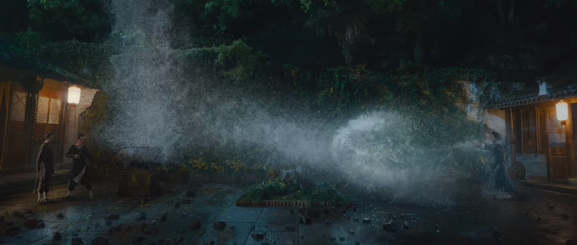
 The real plot of the movie kicks when the Monk witnesses a young man killed by his shifu in a private martial arts duel. This fight marks a shift in the style of the action, and thing get a little dragon-ball Z from here on. He Xia chances into an escalating series of feuds between the different students of a splintering kung-fu school; As the movie goes on the action gets even more fantastic, and soon escalates again from super-powered hand to hand combat to straight up superhero shit with people launching elemental barrages at each other. It's really good for what it is, still full of stunts, cool wire work and fun ideas, and obviously this style has its own long-standing tradition, but I much prefer the earlier, more grounded action.

The Harry Potter school of Kung Fu

 The effects... well, I'll just make the clichéd observation that Asian moviegoers sure seem more accepting of cheesy-looking CGI than we are. I mean, this seems to be a legit superproduction, and the effects are much better than usual for its genre (and leagues better than something like, say, Carter); but even a lot of the good stuff looks very artificial, and some of it is pretty bad. So if that sort of thing is a deal breaker for you, beware. The sets, cinematography, and physical effects are all great.

 The drama itself is where the movie really stumbles. It remains likeable for a while, and I think I was able to follow the plot throughout (which is not always the case for me with Wuxia/Xianxia movies). But it keeps changing the stakes and adding brand-new, important characters we're seemingly supposed to care about right up to the end. Poor He Anxia ends up being more and more of a bystander as other people take center  stage.
 There is at least a through line in that it's all about He Anxia's journey as a monk, going through a bunch of different masters, and there's a lot of Buddhist mystical lessons mixed in, but I didn't find it very compelling - I did make it to the end, and enjoyed it overall, mostly from the goodwill it accrued during its tighter first half.

 It's no surprise to learn it was based on a bestselling novel*. The movie reeks of an adaptation made for those who are familiar with the material, and seems terrified of making any cuts.
 It would benefit hugely from dropping a few developments or amalgamating some characters... but as it stands it's a bloated mess that's happy to  throw in completely extraneous scenes and subplots like some business with corrupt police or a standalone WW1 flashback that adds absolutely nothing to the plot (except some eye-popping explosions; this is definitely a big budget movie.)
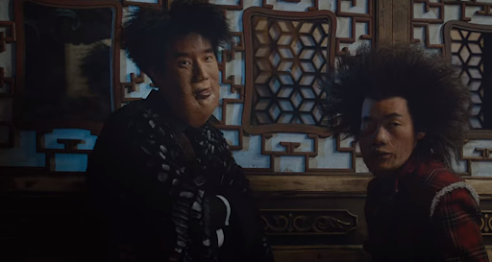
 And there are some weird asides that don't fully work either, like a weird 'humorous' drug trip scene (that also deforms their faces for some reason). Or a romantic interlude that is.... very much not romantic.

This is your face, on drugs

 A shame it couldn't keep its scope reined in. It's unfair to  judge the movie for failing to be what I wanted it to be, but I don't think it really works on its own  terms either, except maybe as an attempt to map to images the contents of a book on as near a 1:1 basis as possible. I can't know if that's the case, or how successful it is in that respect, but as a stand alone story it starts out strong and then fizzles away in a number of ultimately unsatisfying directions.


 *The novel was written by Xu Haofeng, an author who's since made a few martial art movies of his own I intend to watch soon-ish; I've read good things about them.

Saturday, May 21, 2022

Detective Dee: The Four Heavenly Kings

 The Detective Dee series is a weird and interesting one. It's basically Sherlock Holmes done as wuxia, in the form of action movies with a lot of spectacle. Because they take place in a heightened Chinese magical past, it's tough to work out the internal logic, which is important if the main character is a detective. Gravity is optional, giant animals abound and some minor (mostly Buddhist) forms of magic seem to work, but when a storm is summoned in a room it's down to hypnotism and 'machine parlor tricks.'

 The first film did a better job of being a detective story, while the sequel leaned into the more extravagant elements; With this one it's best not to expect too much logic and deduction, and just go with it; It's a fun ride.

 This third installment starts out with Mr. Dee saddled with a powerful weapon which makes the empress jealous; she goes out and gets a few sorcerers to get back at him, turns his best friend against him, and then things turn out to be more complicated

 I'm relatively ignorant with respect to Chinese films, but there seem to be two broad types of historical/martial arts films - Wuxia, more grounded, fights-based films (which I expect is what most of us think when we talk about these things - it's the type of film I'm more familiar with from when I was a kid) and Xianxia, special effects extravaganzas that focus on spectacle (Chinese Ghost Story, Warriors of Zu.)

 I far prefer the first camp, especially since CGI has replaced a lot of the practical effects I enjoy in the second one. Four Heavenly Kings falls firmly in the second category, despite it being set in 'reality' as opposed to a mythological realm, with CGI that ranges from just bad, to so bad it's good, to bad but cool, to actually this is pretty cool- but it's directed by the great Tsui Hark, so it's filled with neat visual ideas and a lot of energetic filmmaking. My particular favorite is a chase with a flying Nazgul trio who proceed to Voltron into a bigger threat:


And every so often there'll be some incredible set or costume. I mean, look at this!


 Unfortunately, beyond the terrible acting and unfunny broad humor that are endemic to these films, the script lets the film down.  I just didn't find it engaging - a lot of scenes which could be taken out with no impact, and a cool story tangled up in bad storytelling. It also has genuinely awesome fight sequences devolve into bad CGI clashing into other bad CGI in garish ways. 

 Detective Dee remains a pretty boring character, one of those uncorruptible, infallible types who seem to have already read the script so they're three steps ahead of everyone else. Apparently acknowledging this the movie focuses on Yuchi -Dee's best friend turned reluctant betrayer- who's a more interesting, conflicted dude, and more importantly his acting style consists mostly of staring at things as if he was willing them to explode with the power of his mind:

 The rest of the cast includes some fun villains and Dee's underlings in the bureau of investigation, who mostly are of the unfunny comedy sidekick variety. The movie also introduces Moon Water, one of the bad guys who later turns coats; She's the one that gets the chase scene with the Voltron Nazguls. Unfortunately she also has to endure a cringeworthy 'sexy' scene with one of the underlings, but seems like a cool character. Maybe the next Dee adventure will find a better use for her.

 Nothing you wouldn't expect from this type of movie, then. Still, though it's uneven as hell it achieves the most important things I wanted from it: it showed me cool shit I hadn't seen before, it was entertaining, and it managed more than a few good-looking scenes. To be brutally honest, I had to skip  through some of the boring bits, but I'd still recommend it if you like this sort of thing.