Showing posts with label Denis Villeneuve. Show all posts

Friday, March 01, 2024

Dune: Part 2

 The Dune books were always just as much about the grand designs and conspiracies of the powerful as they were about the pulpy adventures of its heroes; In fact, those plucky protagonists start out as victims of these machinations, and their journey is to turn into Machiavellian machinators in their own right. It's a complex, thorny saga that doesn't really have a lot of faith in humanity.

 That's something that seems to have resonated with director/co-writer Dennis Villeneuve. Despite having all the trappings of an (artsy) action/adventure sci-fi movie, this is a bleak, fatalistic fantasy.

 After the events of Part 1, Paul Atreides (Timothée Chalamet) and his mother Jessica (Rebecca Ferguson) have narrowly escaped the destruction of their house at the hands of the gleefully psychotic Harkonnen. They are taken in by Stilgar (Javier Bardem), a chieftain of one of the desert tribes of Arrakis, the Fremen.
 Paul humbly joins the tribe, asking only to learn their ways, while Jessica is recognized as a "witch", part of the order of the Benne Gesserit, and inducted as reverend mother of the local order.

 Paul takes on a Fremen name (Muad'dib) and gets to go on adventures harassing Harkonnen spice operations and romancing Chani (Zendaya), a Fremen warrior only seen in visions in the first movie but with a fairly juicy role this time around; Their courtship is pretty sweet - it includes her teaching him sandwalking, which looks like they're doing a synchronized re-enactment of Monty Python's Ministry of Silly Walks skit. She (and her friend) also seem like the only one who's having fun in the movie. Well, she and her friend and Stilgar, who gets a lot of wryly funny lines.

FUCK YEAH.

 While Paul is having fun playing soldier in the sand, Jessica goes to the planet's "uninhabitable" southern hemisphere, where all the religious fundamentalists hang out, to lay out the groundwork for a holy war. Yes, the movie goes out further into fantasy land than the book; But it gives the Fremen some welcome complexity; the northeners look down on their fundie cousins, making fun of them for believing in prophecies.

 The Harkonnen eventually get tired of this new rabble rouser throwing sand (sorry) into their spice-harvesting machinery, and in an absolutely stunning near-monochromatic interlude set in the Harkonnen home planet, they arrange for another scion of the house to go down to Dune to impose some order: Feyd-Rautha (Austin Butler), famously played by Sting in the 1984 edition. His brutal oppression will lead Paul to make some harsh choices.

 It wouldn't be Dune without an extra dozen characters to introduce, so the story expands to include the emperor (Christopher Walken) and his heir (Florence Pugh) and their reaction to this hiccup in spice production.

 The script (by Villeneuve and Jon Spaiths - Eric Roth seems to have fallen by the wayside) has a lot of ground to cover, and moves at a fair clip; That, coupled with its complexity meant that I was always engaged and never felt it drag. And yes, now there's a payoff, it retroactively 'fixes' the pacing and structural problems of the first movie.
 And holy shitballs have they ever stepped up on the visual department. Part One is no slouch on that front, but this film has multiple scenes that had me smiling like an idiot. Villeneuve still hasn't completely cracked how to make exciting action (the swordfights are better this time around, better choreographed), but the level of spectacle on display, and the trippy, imaginative visuals are second to none. None. The scale of some of those things!
 Hans Zimmer's score is still excellent, and this time around it didn't hurt my ears - I'll reserve my opinion on the sound mix until I can watch it on home video at a lower volume, but I suspect it's all right now.

 It also remains fairly faithful to the source material, though less so than the first part. Paul's sister remains unborn here, which was a little disappointing as it was always one of the novel's wackier elements; I'd have loved to see it rendered in these movies' overtly serious style. Instead we get Jessica wandering around whispering like a madwoman to her womb, which is a pretty good consolation prize. A little Prevenge in the year's biggest blockbuster so far.
 Oh, and Chani is no longer the non-entity she was in the books, eventually becoming somewhat of a conscientious objector here, and it adds to the attempts to make the Fremen be a little complex here, and to Paul's journey. I liked that change.
A few other things were changed (that I noticed), but all in all it seems to me that the spirit of the novel remains unchanged.


 Does it have issues? Well, yes, because nothing is perfect except maybe Braindead. Or, closer to home, Arrival.
 I don't mind that it's not really science fiction - that battle was lost sixty years ago, for fuck's sake, move on - but I have a *lot* of conceptual issues with the technologies and tactics on display. The personal shields remain as protective as being wrapped in wet napkins, and surveillance seems to be non-existent (thousands upon thousands sneak up on a capital city without anyone noticing - I know they're desert power or whatever, but come the fuck on).
 There's a whole engagement where ground forces attack a spice harvester that's easily resolved by a laser (which remain hugely overpowered in these movies) slicing the whole thing in half in seconds. Why bother sending ground troops in the first place? And so on; it's all forgivable, but I wouldn't begrudge someone for taking offense at these things - lesser problems have sunk whole movies for me, after all.

 Those are minor niggles. My greatest issue is that, despite giving in and falling into the cadence of an action movie, Villeneuve seemingly remains uninterested in providing an action movie; Many of the beats in the final stretch - especially the final battles - feel oddly curtailed, perfunctory, even when they're providing the sort of cathartic resolution you'd expect. At least they nailed the fight with Feyd, that was pretty good.
 Yes, I know making the action exciting might dilute the message, but come on - might as well go the whole mile to get to your cake and eat it. Or something. Maybe the movie was too long already, but then there were definitely other aspects of the film that could have been tightened to let the action breathe a little more; Leave the finer details for the extended editions. Oh well.

 It feels really petty to complain about such a wealth of awesome stuff, though; It's staggeringly good, and on a pure spectacle level, it puts pretty much anything else to shame. Bring on Messiah of Dune, I can't wait to watch Timothée staggering around the desert in a drugged-out haze for two hours. As long as it looks half this good, I won't complain.

Tuesday, February 27, 2024

Dune: Part One

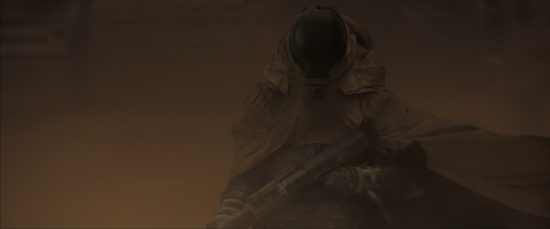
  There's a scene close to the beginning of Denis Villeneuve's interpretation of Dune that's probably made the hearts of sci-fi nerds of a certain age and over skip a beat.

All it's missing is a Jim Burns signature along the bottom.

 This comes after a glimpse of a strikingly armored sci fi guard, and accompanies a an equally lyrical description of the planet Arrakis and its struggles. I am, Villeneuve is saying, one of you guys. He probably is: even if you don't take his results at face value, he'd been talking about this as a passion project from a long time back, and you just know he had to fight to get people to finance it.

 This adaptation is a staggering achievement - a faithful reconstruction of a novel that was long considered impossible to bring to the screen (I'm actually OK with David Lynch's attempt, but it just reinforced that image). James Herbert's 1965 novel is dense with ideas, a soft science fiction epic that focuses on society, politics and religion with remarkable originality and complexity. It's weirdly paced, truly bizarre (admittedly, it gets weirder on the sequels), and features loads of info-dumps and internal dialog.
 Given all of this, it's no wonder that Lynch failed - what surprises me is how close he got to succeeding, behind-the-scenes drama and all. And now comes Villeneuve, and makes a movie that not only towers over Lynch's effort, it's also much more faithful to the source material.
 It's crazy that this isn't even Villeneuve's best sci-fi film.

 The story concerns the machinations of an empire eight millennia into the future, when humanity has spread into the stars, carrying its cultures and religions to all sorts of different worlds. The planet Dune, properly called Arrakis, is vital to the empire as it is the sole source of Spice, a sort of space dope that starship pilots can use to properly chart courses among the stars. At the beginning of the story, the emperor changes the noble family in charge of exploiting the planet - from the dastardly Harkonnens to the noble house Atreides.
 (And anyone who knows a little Greek mythology will groan at that name; They might as well fly to dune on a ship called Icarus, and call their first colony Roanoke).

 There's other players in the drama: There's the Fremen, native (well, you know what I mean) to Arrakis and in a state of almost constant insurrection, and the Bene Geserit, an all-female illuminati-style order with mystical powers. The film first centers on the attempts of House Atreides to peacefully consolidate their position in the planet, and then on what happens when some pretty non-peaceful Harkonnens come knocking... and the fallout from their invasion. There's a 'chosen' one narrative where the heir to House Atreides is at the center of an ancient prophecy, but just like in the book it's clear that the prophecy has been carefully seeded to manipulate events from the shadows.

 It's a busy, busy film, one that expects you to learn all sorts of funky terminology, keep track of multiple threads, and take a bunch of weird concepts in stride. The way Villeneuve manages it is by splitting the novel into two halves, of which this is the first one. It was a risky maneuver - what would have happened if the first movie didn't find an audience? - But one that thankfully paid off. The extra breathing room allows Villeneuve and his co-writers (Eric Roth and Jon Spaihts) to lavish the planet and far future societies with attention, and a whole lot of talented people spent untold amounts of money bringing Herbert's word to the screen as organically as possible.

Seriously, that introduction...

 The effects and artistic vision are amazing, and the production design - wardrobe, vehicles, buildings - is top-notch, intricately detailed and with an impressive sense of scale. Action-wise it's good; The surprisingly prevalent hand-to-hand fights are just OK (and they sure make a whole lot of noise about those shields for them to matter very little in the end), but I haven't seen any other movie where lasers seem so fucking dangerous as they do here, and there are a lot of extremely cool-looking explosions. Everything looks, as you'd expect from this particular director, absolutely incredible.

 The acting is all shades of great, with strong central performances from Oscar Isaac, Timothée Chalamet and Rebecca Ferguson, and excellent turns by names like Josh Brolin, Stellan Skarsgård, Dave Bautista, Javier Bardem, and Jason Momoa.

 As good as it is, the film does stumble in a few areas. I'm not a fan of the sound mix - Hans Zimmer's (excellent but bombastic) score overpowers everything else, leaving some of the action weirdly low-impact. The script also struggles finding a cutoff point; The movie has a clear ending, but it plows through it and continues for yet another hour, leaving the events of this last third feeling inconsequential, despite being well-integrated into the story. The film's climactic confrontation, for example, is based on someone's unwillingness to kill - which might well be very relatable, but as a concern it comes out of nowhere, so the stakes aren't too compelling. Especially with everything that went on before.

 And a little too much is made of the mystical visions, which don't really pay off meaningfully.

 Yet. I suspect that these last two issues will become a moot point once the movie is completed with Part Deux. After all, as someone cheekily says as the last line in the movie: this is only the beginning.

 I'm just hoping they succeed... just to see how the hell they adapt Dune Messiah, which is a properly freaky (and pretty boring) book. 

Wednesday, December 06, 2023

Incendies

 Jeanne (Mélissa Désormeaux-Poulin) and Simon (Maxim Gaudette), two twenty-something twins, get an unusual bequest from their late mother Marwan (Lubna Azabal): Two envelopes, one to be delivered to their father (whom the twins thought was dead), and one to be delivered to a third brother (whom the twins knew nothing about).

 Until these are delivered, the mother is to be buried naked, face down, and with no tombstone - as befits an oathbreaker.

 It's an immediately enthralling premise. Simon wants nothing to do with this madness, but Jeanne travels back to her mother's fictional Middle East homeland (the film was shot in Jordan, but the story echoes some Lebanese events) to slowly uncover her mom's history. Which includes a forbidden love, all sorts of turmoil, a radicalization, imprisonment - the twins soon become background characters as Marwan's story is told in fragments, her arc slowly becoming apparent. It's an extremely novelistic approach that works beautifully as the individual parts are compelling and the mystery is an interesting one.

 Until the very end, which contains a couple of very contrived, extremely improbable coincidences which... well, which kind of break the movie. Not just because they strain any possible suspension of disbelief - they're integral to the movie's development, so you could take it as a sort of magic-realist development - but because of the light they cast on Marwan's bequest. I mean, it was always going to be a overtly writerly plot device, but it ends up looking like a cheesy psycho masterplan - the sort of thing you'd see in SeSevenven or the Saw movies.

 And it's a shame, because so much of the movie is so good. Denis Villeneuve was already an established director when this was made, and his style is in top form, keeping events flowing cleanly and the sense of menace ever present - the film runs over two hours, but the expert pacing and well-developed script (by Villeneuve and Valérie Beaugrand-Champagne, based on a play by Wajdi Mouawad) more than justifies it. It's also punctuated with a deeply upsetting action scene (of the war-is-hell variety) that's as good as anything he's ever shot and casts a long shadow over the events of the back half.

 All the actors acquit themselves admirably, with Azabal especially good as Marwan - she carries a lot of heavy scenes pretty much on her own. Cinematographer André Turpin gets in a lot of striking shots, including a beatiful and disturbing opening shot featuring soon-to-be child soldiers set to a song from Radiohead's bleakest period.

 Overall I really liked the movie, as I feel its strengths compensate for its one eventual weakness, but those late-film revelations make it really hard to recommend. That's always a risk with this sort of puzzlebox approach to scripting. I get that it's aiming for a literary feel, more of a Russian novel than a mainstream film, but it ends up coming across too much like a telenovela.