Showing posts with label France. Show all posts

Saturday, July 19, 2025

Hostile

 A post-apocalyptic zombie movie, intecut with a cute romance story which is a) surprisingly integral to the film, and b) intended for women, which is still pretty rare in this type of film. Yes, I am deliberately not counting Twilight or other YA movies as 'serious horror'. Bite me.

 Juliet (Brittany Ashworth) is a rough, no nonsense driver out scavenging for supplies for some survivor settlement out in an arid, zombie-infested wasteland. She has a spectacular crash, and has to fend off both living and unliving menaces while dealing with a serious injury (an exposed fracture, of course) and trying to get a rescue organized.
 While she does this, different prompts cause her to have flashbacks to her life in New York before the zombie outbreak as she met and fell in love with rich French dreamboat Jack (Grégory Fitoussi)

 The love story is very well made, and a little too romantic for my taste. Jack is, in his own way, just as implausible as your regular Manic Pixie Dream Girl (Steady Wealthy Dedicated Dreamboat?) - someone who's utterly smitten by and devoted to Juliet right from the beginning, sensitive, assertive (sometimes to an uncomfortable degree, but always to his paramour's benefit), rich (but conflicted about his priviledge), ludicrously handsome.
 None of those criticisms are valid as that's exactly what it wants to be; I'm just not wired to like this sort of thing - I'm more of a Before Midnight than a Before Sunrise person, and found it all a bit too cloyingly sweet and, well, idyllic despite featuring at least a little darkness. My preferences aside, this is at its heart the rare romantic horror film and it should be celebrated for that. Everything is obviously leading up to a grand romantic tragedy in both of its timelines, and honestly, the lead-up is fine.

 The problem is just where it's all leading to; There's a climactic, wildly implausible development that will severely test anyone's faith in the script, and it also paints much of the preceding action on the post-apocalyptic sections of the movie as a bit of an idiot plot, if I'm going to be a dick about it. In its defense it's the whole point of the film, but... it's rather a lot to take in.

 Still. There's a lot to like here. Both halves of the movie are well-made, with distinct filming styles, and structurally it's sound (even if the prompts for switching to the flashbacks are a little flimsy). Writer/director Mathieu Turi has a good eye for low-budget action (there's a very amusing early scene where the film shows - or rather, doesn't  - a fight against a zombie from outside of a camper van) and manages some really striking shots (the post-apocalyptic segment is mostly set around the upturned wreck of Juliet's car, and it manages to  look eerily beautiful; Turi and cinematographer Vincent Vieillard-Baron manage to do a lot with mood lighting). There's some gnarly, brutal gore (including a very well-made skull crushing) and the makeup effects for the creatures are pretty good.

 Ashworth is good in the main role, and her character is fairly well-rounded. I just wish Jack was a little less of a generic fantasy fulfilment hunk, but... well, I'm not the intended audience here. The twist is a bigger hurdle, even if it is baked into the story. Warts and all, though, it's a likeable film, a very solid bit of survival horror, and it tries to do something unusual; That counts for a lot around these parts.

Saturday, April 19, 2025

Summit of the Gods (Le sommet des dieux)

  Makoto Fukamachi (Damien Boisseau) is a Japanese photojournalist drinking away his frustration as the team whose Everest ascent he was documenting turned back before they could reach the top. When a shifty characer approaches him to offer him a camera belonging to one George Mallory, who had attempted to conquer the mountain back in 1924, Fukamachi turns him away. But his interest is piqued, and he follows the man out.

 Before he can approach him again the camera is taken by another man, who in turn slinks away into the shadows. The surprised Fukamachi recognizes him: Habu Joji (Éric Herson-Macarel), a once up-and-coming fellow Japanese climber who disappeared years ago without a trace.


 Back in Japan Fukumachi starts investigating Habu, rebuilding the man's life through archival data and interviews with old acquaintances. His work eventually pays off, leading back to Nepal and an unexpected attempt to help Habu complete some important unfinished business.

 Summit of the Gods is a quiet, contemplative French animated character study based on a Manga of the same name by Jirô Taniguchi (which is in turn an based on a novel by Baku Yumemakura). Director Patrick Imbert and his crew have carefully shepherded the adaptation to the screen; The art is beautiful, with crisp, clear lines, sharp colours and gorgeous backdrops (expect lots of tiny figures framed against giant rock formations). The traditional, 2D animation is detailed but oddly muted, always aiming for realism and not expressivity. Everything is rounded off by a gorgeous soundtrack courtesy of Amine Bouhafa.

 The film's script (by the director, Magali Pouzol and Jean-Charles Ostorero) is built around two well-written characters (both fictional, although Mallory did exist). Their story is relatively simple but beautifully told thanks to an elegant structure that patiently paints a picture of Habu from Fukamachi's investigations. The two timelines interweave and fold together seamlessly to coalesce into an examination of why people like Habu gamble their life over and over again for the sake of a new, highly-specific record. No conclusions are reached, of course - but whenever Habu conquers some difficult challenge (the specifics of which are painstakingly drawn and animated) or reaches a summit, you can almost see the appeal.

Thursday, March 06, 2025

Smoking Causes Coughing (Fumer fait tousser)

 I'm pretty fond of French nutjob Quentin Dupieux. His movies may be somewhat half-baked, indifferently shot, and often frustrating - the guy has next to zero interest in conventional narrative - but they're always funny, batshit crazy, and at the very least interesting.

 Smoking Causes Coughing is, as far as I know, his first superhero movie. And by that, I mean it's a Super Sentai (Power Rangers, basically) spoof that soon loses interest in its setup and digresses into a series of short stories first told by the cast, then characters who stumble into the frame, and then... well, best not to spoil one of the film's biggest laughs.

 Benzène (Gilles Lellouche), Methanol (Vincent Lacoste), Nicotine (Anaïs Demoustier), Mercure (Jean-Pascal Zadi) and Ammoniaque (Oulaya Amamra) are the Tobacco Force, a group of superpowered avengers that assemble into a deadly, toxic force. They are introduced fighting a beautifully crafted Power Ranger-esque walking turtle in a scene that has got it all: Flying kicks, ineffective shuriken, the line "Let's give him a cacer!", and a joyful shower of viscera that somehow reaches a distant family watching the fight through binoculars.

The actors actually stumble back before the barrage of oncoming entrails. It's glorious.

 During the fight, Mercure has some problems focusing his powers, as apparently he's not sincere enough. And sure enough, after the fight their splinter-like boss (Alain Chabat voicing and operating a hilariously dingy puppet) tells the team that they must go into a retreat to learn to work together again.

 There's an intergalactic threat they need to prepare for, and all sorts of interpersonal conflict and insecurities they obviously need to work through, but that'd be boring. So when Benzène tells a scary campfire story (a ridiculous, but mostly deadpan Deerskin-like slasher tale), different characters come out of the woodwork to tell their own bizarre horror-adjacent stories.

 Dupieux films everything with his usual flat style and a washed-out '70s palette. It's not a bad-looking movie, but part of the fun is how ramshackle and workmanlike it looks. The soundtrack is all dusty, cheesy French pop, and the gore effects are basically people hurling buckets of offall at the characters from off-screen. There is a pretty nifty disembodied mouth effect I imagine was done with CGI, but other than that it's not really the sort of movie that distinguishes itself visually. The cast, which consists mostly of French and Belgian TV and comedy vets (plus Adèle Exarchopoulos) is game, but this is the sort of material with which even the best acting would feel stilted... and you wouldn't be able to tell if that was the intention or not.

 On the plus side, it's a great showcase for the writer/director's inventiveness, it boasts a genuinely surprising, unpredictable structure, and the gags range from genuinely solid jokes to absolute headscratchers that are somehow still funny. If you have any tolerance for truly surrealist humour and some patience, this is a great point of entry to Dupieux's bizarre filmography.

Saturday, February 22, 2025

The Soul Eater (Le mangeur d'âmes)

 Elizabeth (Virgine Ledoyen) is a mannered, gives-no-fucks police inspector investigating a bizarre double-homicide in the French province of Vosges; Franck (Paul Hamy) is an intense, driven young Captain who's on the trail of some missing children (he's introduced screaming while jogging himself ragged, which is blatant film language to let us know he's troubled.)
 Together, they fight crime. Kind of.

 The Soul Eater is a sort of collage of detective media from the last couple of decades, a film built almost entirely from common places, plot holes and contrivances tied together by a mystery that only gets shittier as the movie unspools its unlikely tangle of elements. It also throws in a possible supernatural threat and a few Nordic Noir-style disturbing plot elements to try and spice things up, which only makes its half-assed-ness feel tackier.


 It's never able to shake off the feeling that you've watched it before, but for a while it works; Both protagonists are fun to watch and their investigation at first seems interesting. Directors Alexandre Bustillo and Julien Maury know their way around a production of this sort and provide some good atmosphere.
 The two investigators' cases (the child abductions and the double murder) are linked, of course, and they soon learn of a local folkloric figure - the titular Soul Eater - who gets a shitty rhyme to say how he comes out of the woods to eat people and leave behind evil doppelgangers or something.
 There's also a mysterious motorcycle rider, a plane crash in the woods that keeps being brought up, and more police incompetence than you can shake one of those weird little wooden soul eater totems that keep appearing at all the crime scenes. And yes, more people soon start showing up dead all over the sleepy town.

 The French, of course, are adept at taking Hollywood crime movie conventions and making them their own - or at least making a banger out of them. The clearest influence here is 2000's The Purple Rivers (the directors have admitted as much). But there's not enough of anything here to sustain interest; the style is mostly subdued, there's very little action, and the police procedural/mystery elements hinge on people missing the obvious and other dumb conceits; The script, by Annelyse Batrel and Ludovic Lefebvre, adapting a novel by Alexis Laipsker, is a complete mess.

 Bustillo and Maury have ever been reliable providers of genre thrills, but while their gorehound sensibilities do give this one a welcome spike of nastiness (the only time the film comes alive is a cruel, bloody late-movie portrayal of the inciting crime), there's not much they can do here other than keeping things nice and atmospheric. There are a couple of perfunctory foot chases, a couple shootings and a pretty neat car/bike stunt; Aside from than that, everything relies on the mystery itself - and its resolution - to hold things together... a task at which it fails, miserably.

Monday, December 30, 2024

Tokyo Grand Guignol

 Four French directors, working with a mainly Japanese cast and crew, are given equal (tiny) budgets, schedules, and a mandate to shoot something in Tokyo that explicitly invokes grand guignol tradition of gleeful carnage. No frills, no framing story, just four shorts of varying fucked-upness. Let's go!

 First off is Yann Moreau's Endless Love, where Shinichi (Hiroyuki Mori) gets stuck in a time loop. Time loops aren't that great, but the day Shinichi is stuck in is particularly bad - his beloved wife's died less than a month ago, and the Yakuza he borrowed money from to pay for her operation keep sending thugs to put pressure on him. After contacting a suicide agency (as you do!), he finds out that the agency had someone else on file with the same problem - and apparently, they found a way out of the loop... by sacrificing someone else.
 Shinichi successfully tests out the hypothesis with one of the Yakuza, and quickly figures out that it has a second, undocumented side effect - one which he can exploit to travel through time. But that will need a lot more sacrifices.
 It's a silly, mostly non-sensical tale that works mostly thanks to a very committed performance from Mori, slinky, crisp, very stylish digital cinematography, and very solid, Dardenne-esque handheld camerawork - especially during a couple of chases through the city's narrow streets and byways. It looks lovely. There's even a pretty cool one vs. many action sequence with some decent choreography, though it's marred with some truly terrible CGI gore (more on this later).

 Then comes the highlight of the collection: Trahison (treason), by François Gaillard, a director who seems to specialize in Giallo homages. As exemplified by his contribution here, a gorgeous, tale of supernatural menace that goes heavy on dream logic and ambiance.
 Nami (Megumi Nasano) spends her nights dancing alone at nightclubs and drinking moping around her apartment after a nasty breakup. But when she tries on an evil hairpin (we know it's evil because the excellent retro synth soundtrack helpfully turns ominous), she starts being harassed by her creepily smiling reflection (I do wonder if Parker Finn saw this). There's not a lot of story, just some cool supernatural weirdness: A slumbering Nami is molested by her shadow, a hapless neighbour (Haruka Yamamoto) gets killed with the hairpin, mysterious phone calls, an inscrutable cat...
 It all looks beautiful - the lighting and production design brings out the requisite blue and red hues that are what most people take from Suspiria, but pulled off with more elan than usual. There's a lot of off-kilter coolness, some very cool editing, and the lone kill is a vicious, wonderful throwback to the Italian masters. You know the ones I'm talking about. This one's worth the price of admission alone.

 Gilles Landucci's Shadow Hunter is a very otaku fantasy - a pixie-ish twenty-something woman (Satomi Kurebayashi) belongs to a shadowy conspiracy that sends her out to hunt demons (or ghosts) only she can see, to kill them with a special high-tech phosphorus gun.
 The demons are... well, they're basically fucking mimes with the ability to jump into shadows. One of her quarries (Shuhei Ohkawara) ends up getting curious about her, starts haunting her, falls in love, all while Eri deals with some of her own personal shit.
 It's a kind of cute story, but it's slight as all hell and it doesn't hold much interest neither on the story nor the visual department. 'Mimes. Why does it always have to be mimes?', muttered no one, ever.

 And finally we get to Nicholas Alberny's Good Boy, which is... how do I even describe this one. If you were desperately looking for a graphic depiction of exactly what happens to someone's penis during a werewolf transformation and Wolf Cop did not tide you over, you're in luck!
 It follows the (mis)adventures of Hidesaburo (Jigoroh), a callous asshole first seen calling his mistress a whore in no uncertain terms and then carving a rude message on a Tokyo landmark with his penknife. The landmark is the Hachikō statue (which gets its own, very shoddy animated prologue), a depiction of a dog that exemplifies loyalty; Hachi takes exception to this mistreatment at Hideboro's hands by turning into possibly the worst digital effect I've seen on film in a very long time - it looks like a really shitty motion comic, a 2D image poorly manipulated to give some semblance of life:

It looks even worse in motion. A hell of a lot worse.

 The dog bites Hidesaburo and goes back to statue mode. The bite victim then wanders off in a daze, walking through the red light district until Momo (Ayumi Tomiyama), a prostitute, takes him off the street.
 Hidesaburo is, of course, turning into a werewolf, and imprints on Momo immediately, following her everywhere with puppy eyes. This unsettles the clientele and workers at the brothel, leading to a confrontation with the local Yakuza. Unlucky for them, then, that it's a full moon outside...

 Where to even start with this? The 'plot', such as it is, is all kinds of terrible. And it looks appallingly bad: Not just the CGI, which remains terrible throughout, but the flat, desaturated digital video they went with drains every scene of life. The werewolf makeup, for the record, is pretty fun
 But if you can ignore how it looks, it's a fucking riot. There are a lot of really great jokes (my favorite one being a novel use for a weird stool with a hole in the middle). The morphing penis I mentioned above also got a huge laugh, as did a hapless Yakuza who tries to intimidate the werewolf by flashing him his badass yakuza cat tattoo, Momo servicing a client in multiple ways as she fields a phone call, and a few more very silly gags.
 As an excuse to go all out on ridiculous ideas, it's a success. Shame about the execution. The director of this short also worked on some effects for the others, and a quick search reveals a failed IndieGogo campaign to complete the film (12% of approximately £8000). I guess that explains that. My guess is Trahison wasn't affected because it was conceptualized as practical effects from the beginning.

 On the whole, though? As mentioned above, one of the shorts alone is reason enough to recommend it. The rest are at least ok; I think the main problem, besides that they ran out of money [citation needed] is that most of these are too long: the first one struggles to fill out its prescribed 30 minutes, and the runtime seriously sinks Demon Hunter, which barely has material for half its length. On the plus side, all the shorts have a distinct look and sound, most of the acting is pretty decent, and they all frame different aspects of Tokyo in appealing (or at least interesting) ways.
 With some bits excised out, maybe another pass at the effects, I'd be much more enthusiastic about singing its praises; As it is, I'd happily recommend it on the strength of Trahison, with some heavy caveats for the rest.

Friday, December 27, 2024

The Theatre Bizarre

 A young woman visits the seemingly abandoned Guignol theater, only to be greeted by an MC (Udo Kier!) who introduces, mime-like, five stories with varying (but tending to high) levels of depravity and bloodshed.

 The original Grand Guignol theatre in France specialized in plays featuring graphic displays of gore and sex, to the point where the words today are used to describe over-the-top, sadistic violence and splatter (sex, not so much). Most of the stories in this anthology film certainly do try their best to live up to that- or down, depending on your taste. Well, with one exception, but we'll get to that.


 The wraparound segment with the woman at the theater and Udo Kier is directed by Jeremy Kasten. It does have a premise of sorts, but really it's just a cheesy way to introduce the different stories. It's fine for what it is, though personally I find the would-be-creepy human puppets look like shit.

 First up is the folk horror/Lovecraft mashup of 'The Mother of Toads', an adaptation of a (good) Clark Ashton Smith story, tied closer to the wider Cthulhu mythos by avowed Lovecraft fan Richard Stanley.
 It's pretty fucking terrible.
 Two American tourists (Victoria Maurette and Shane Woodward) fall under the spell of a witch (the legendary Catriona McColl, with porn star Lisa Belle subbing in for some... key scenes) while touring France. She lures the man promising access to a copy of the original Necronomicon, only to seduce him after poisoning him with mulled wine. There are loads of cute toads, a Creature from the Black Lagoon with two sets of tits and a cool corpse puppet, but just about everything in this short is atrocious - from the acting (at least McColl seems to be having fun) to a complete lack of tension or anything interesting going on. They completely mangle the original story, and do without its amazing ending (which, to be fair, would have been hell to shoot, especially with this budget).
 At least the scenery is nice (Connecticut passes for the fictional province of Averoigne). Other than that, this is a complete waste of twenty minutes.

 Things get better, thankfully, with Buddy Giovinazzo's 'I Love You'. It's a Berlin-set tale of a disintegrating marriage (between André Hennicke and Suzan Anbeh) that ends with a simple, but effective twist, followed by a bleakly humorous capper. The acting is much, much better, as is pretty much everything else.

 Then comes Tom Savini's turn; The man's built a bit of a secondary career directing horror shorts. It's a fun, lurid Tales from the Crypt-style shocker depicting a Sandman-esque scenario of nested nightmares ... about genital mutilation. That's fine, since we get plenty of chances to root for the protagonist's (James Gill) wiener getting chopped off - the guy is a massive piece of shit. Debbie Rochon plays his no-longer suffering wife, and Savini hams it up as a sleazy psychologist. Features a plate of severed penis and mash, plus a 'Lovecraftian vagina' (their words, not mine).

 'The Accident', by Douglas Buck, is a complete outlier: an entirely tasteful reverie built around a frank conversation about death between a mother (Lenna Kleine) and her very young child (Mélodie Simard) after they witness a gruesome accident.
 It's not a particularly deep conversation, but it is heartfelt and real in a way films, particularly genre films, struggle to get right.
 The music is great and the filmmaking is on-point, with some staggeringly beautiful roadside scenery and a dying deer so realistic I stuck around the credits to make sure the 'no animals were harmed in the filming of this picture' disclaimer popped up (it did). The acting is as naturalistic as the script. A gorgeous little short, its power magnified several times over for being nestled between all this cheerfully depraved material.

 And then we're back to the muck with Karim Hussain's 'Vision Stains', although it's quickly apparent some of the previous story's lyricism rubbed off on it. Unfortunately, its lyricism is of the florid, pretentious sort, as a woman (Kaniehtiio Horn) provides constant narration as she gruesomely harvests the memories off the junkies she murders. If you're not a fan of the part of the Venn diagram where eyes and needles intersect, you might want to sit this one out.
 The problem is that the narration's prose is infuriatingly overwritten (just like my reviews!) and delivered in a dead-voiced monotone. Things get a sorely needed shakeup when an extremely unlikely development leads to the woman getting a sort of metaphysical comeuppance... Maybe the script didn't buy into its own writerly bullshit after all.
 This one was a bit of a chore to get through, but it's well made, has some indelible imagery, and it's beautifully shot - Hussain's an established cinematographer with some impressive credits over the last decade or so. In light of its final twist, I'd say it's a keeper.


 David Gregory goes last - he's a prolific director of genre documentaries and featurettes. His segment, 'Sweets', is a garish, borderline surrealist story about the romance between two food fetishists (Lindsay Goranson  and Guilford Adams) and its inevitable conclusion.
 In an anthology centered around the grotesque and the bizarre, this one holds the honour of making me look away. It's not the gore that did me in, though (though there's some fun stuff here) - it's all the feeding and vomiting. Turns out I'm definitely not into whatever these people are into.
 Even if it weren't for that, I didn't like this one. Its frequent gross-out moments, shitty art-school satire and over-the-top sleazy aesthetic are calculated to repel and... guess what? It repelled me.

 The whole film mostly suffers from a flat, digital look (with The Accident and Vision Stains as honourable exceptions) and the sound mix is often off, with overblown music often threatening to swallow everything else in the mix. The gore effects, on the other hand, are top-notch.
 The Theatre Bizarre certainly delivers on its title, and on the gleeful descent into debauchery and bloody mayhem promised by its invocation of the Grand Guignol spirit - with The Accident both anchoring it and unexpectedly elevating it; Even with two complete misses, and at a very long two hours, I'd say it's a worthwhile collection.

Saturday, September 28, 2024

The Substance

 It's possible to use satire subtly. It's not all that common, especially in movies- after all, even when they go over the top, people still take them at face value. I have some sympathy for this: we should never forget media literacy is a skill, and that many people don't consume enough fiction to develop it.
 Still - I do wonder if there's someone, somewhere, who could mistake writer/director (and editor, and producer) Coralie Fargeat's The Substance for... I don't know, a feminist cautionary tale about science run amuck or a particularly unpleasant body horror film.
 It is pretty much at the opposite end of the galaxy from subtle, is what I'm saying. And damn if it isn't entertaining.

 Elizabeth Sparkle (Demi Moore)'s star is falling. That's made hilariously clear in a brilliant (and brilliantly unsubtle) montage where her star for the Hollywood Walk of Fame is first built (in a gorgeously extended, very procedural scene), then admired, then forgotten, ending in a scene where a guy drops a very sloppy burger on top of it.
 She's now fifty, and as we catch up with her she's being callously fired from her long-running aerobics TV show by an exec played with sick, sick relish by Dennis Quaid. This leaves her in a tailspin which I think any of us can relate to, even if we don't have her financial stability, and will never be as gorgeous as she is at 50. (Or as Moore is at 60, while we're at it).

 And then someone passes her a USB stick with an ad for an enigmatic product called "The Substance" - the marketing campaign sits somewhere between a body spray ad and the latest promo for some overrated techbro's latest scam. It's accompanied by a note saying "It changed my life".
 At first Elizabeth rightly scoffs, but after a series of insults and degradations she caves in to curiosity and manages to get a hold of the product itself. It's a series of vials, injectors and other medical-looking paraphernalia boxed carefully with enigmatic instructions to follow. All printed in a large, bold letters. It goes well with the techbro vibe from the commercial - it looks like a high-end consumer electronics product; Wonder if that's how beauty products are marketed these days.

 In any case, Elizabeth not only easily works out what to do from the instructions, she also shoots herself full of needles with the ease of an inveterate junkie. And lo and behold, after some unpleasantness, out of a long crevice that opens on her back pops out a younger woman who will later call herself Sue (Margaret Qualley). She's everything Elizabeth feels the world wants out of her / everything she would like to have again; Young, curvy, unattainably beautiful. At first I thought there was some sort of conscience transfer involved, but no, it soon becomes clear they're two separate people.

 The science is ridiculous on its face (conservation of mass can bite it!) but it's a neat and well thought out concept with its own internal logic. Even if they have two different bodies, Sue and Elizabeth have to time share their lives for a week at a time; As the instructions keep telling them, they are the same person. So when Sue goes out and starts conquering Hollywood - by... um, taking over Elizabeth's old show, Elizabeth spends that time unconscious in the bathroom floor, and viceversa.
At first Elizabeth lives Sue's life vicariously through TV tapings and billboards. But the rot soon sets in, and they both start resenting the time the other woman takes up in their life. And thanks to some slight misuses of The Substance, that rot is pretty quickly made manifest. Thigs go downhill quickly. And spectacularly.

 Coralie Fargeat made an impression with her excellent Revenge - an, um, rape/revenge genre exercise that was actually fun and included loads of uncommonly cool visuals and poetic, almost avant-garde flourishes. This, her follow-up, confirms her as a ferociously talented, inventive writer and director. There are so many incredible scenes, clever transitions, and great visual gags and callbacks.
 It's not just immaculately crafted, but very carefully put together; The sort of movie where, if, say, a finger gets hideously mutated due to The Substance abuse, you can bet your ass it's going to crassly feature the deformed appendage in as many extreme close-ups as the film can squeeze in. And I don't think a chapter title card has made me laugh so hard since Aniara. It's all portrayed with gooey, convincing, disgusting effects - most of them practical, and an outstanding sound design that prioritizes all the gross sounds our bodies make. I imagine the Foley artist had a lot of fun recording some of these.

 And Moore and Qualley are incredible, both in pretty ballsy roles. Might be a bit cliché to call their performances fearless, but that's pretty much what they are. Moore in particular really goes for it in a role that runs the gamut from brittle self-loathing to all-out evil hag. 

 I don't want to oversell it. In many ways, it's a bit of a misfire; For one, it's extremely bloated. Even if you count its excess as part of the joke (it absolutely is) that doesn't make the experience of watching its slow parts any better. And if you don't like blunt symbolism... well, you might hate it. I got onboard pretty quickly, but even then a couple of over-the-top conceits made me cringe, and not in a good, body-horror "oh my god don't put that needle there" way.
 But it's not like its messaging is all that simple either. I mean, some of it is - Take Quaid's sleazeball, one-note executive - the guy is so over the top he could basically be a villain in one of the Schumacher Batmans, one whose power is being overbearingly entitled/chauvinistic/etc.
 And then the film delights in both Sue and Elizabeth behaving horribly, and the obligatory 'Can't you just smile?' joke here is hilariously anti-intuitive.
 Don't get me wrong; It's feminist and angry as fuck. Both women are shaped by the people and the industry around them, and their antics are ultimately tragic. But if that's the message, that's not what the film focuses on, instead providing a cavalcade of Cronenbergian horrors, bleak jokes and enough bloodshed to unseat Project: Wolf Hunting in the "most gallons of fake blood spilt" sweepstakes.

 The script also doesn't give a flying fuck about plausibility, but that's honestly a tiny concern, since things are clearly heightened to ridiculous levels from the get-go. Crowds form mobs with the ease of a Simpsons or Spongebob Squarepants cartoon, morning gym shows throw shapely asses at our face like the tackiest of hiphop videos and catapult their star into being America's sweetheart in a couple short months, and most men behave like Tex Avery cartoon wolves.
 Finally, it's a pretty disgusting movie. But if you read this blog then you're probably on-board with that. My problem, ironically, is that the ending's outrageousness had been a bit over-sold to me by a friend - so I found it underwhelming when compared to... I dunno, Society or Men. But it's still a good one. It made me laugh.

 I think I prefer Revenge's simpler pleasures to this movie's all-maximalist-all-the-time approach. But it's quickly growing on me, not the least because of the near-inexhaustible levels of enthusiasm and inventiveness Fargeat shows behind the cameras; I can't wait to see where she heads next.

Sunday, June 23, 2024

Inside (À l'intérieur)

 The first thing we see in Inside is a fetus floating snugly in its womb - then something happens and the baby hits the camera lens with its face, a cloud of blood invading the frame. Extremely unconvincing CGI aside, it's one hell of a way to kick off a movie.
 The cause for the baby's discomfort soon becomes apparent as we get our first glimpse of our pretty pregnant protagonist, Sarah (Alysson Paradis), in the aftermath of a horrific car crash. She's survived; Her partner, unfortunately, didn't.
 As it turns out, her baby survived the crash as well, something Sarah seems a little ambivalent about when we catch up with her a few months later. It's the day before Christmas, riots are rocking suburban Paris, and it's the day before she's due to go to the hospital to have her baby delivered. Sarah goes around in a haze of depression, still clearly struggling to come to terms with facing the rest of her life - and looming maternity - alone.

 That night, a mysterious woman (Beatrice Dalle) knocks at her door and asks to be let in - and later appears in her garden. Sarah is justifiably unnerved, enough to call the police, who promise to patrol the area and check in later. It's no good; As soon as she goes to sleep, the stranger breaks in and wanders her house, watches her sleep, brandishes a very nasty pair of scissors a little too close to her belly...
 After a brutal, wince-inducing attack at about the half-hour mark, Sarah ends up locked in the bathroom while the stranger paces outside, demanding Sarah gives herself up for butchery. The movie never lets up, going through a handful of established characters that meet various horrifying ends. It's a relentlessly brutal, extremely gory and harrowing home invasion that quickly leaves poor Sarah covered in blood from head to toe.


 Besides being one of the poster girls for the horror branch of the French New Extremity 'movement', Inside marked the debut of the writer/directing duo Alexandre Bustillo and Julien Maury, who've since built up a pretty cool and varied body of work within the genre. This one remains their bloodiest and their best.

 It's very much of a piece with the other horror movies from the 00s, except much better than most. The CGI baby - who pops up multiple times to give the film an even more jagged edge - is a great bad-taste concept, but unfortunately the execution is so laughably bad that it counts against the movie even as it makes it more memorable. The same goes for other scenes where CGI is used, including a conceptually cool but visually botched face-torching moment.
 Elsewhere, though, the computer imagery is not that bad, mostly because the film wisely limits their time on screen to very quick flashes. The more prevalent practical gore effects are appropriately disgusting and over the top - expect blood to cascade down stairs and shoot out in almost comical high pressure from puncture wounds. There's face explosions, disembowelments, and more stabbings than you can shake a pair of oversized scissors at. The carnage is graphic, extremely well made and brutal enough to undercut a gorehound's glee. Almost.

 More than anything else, it's an excellent and particularly bloody single-location slasher. The script hits a couple of bum notes but mostly nails the give-and-take between suspense and mayhem all the way to a fucking excellent, bleak-as-all-hells finale.
 The two women at the center of the film are great characters - one melancholy and relatable in her orneriness, the other one inscrutable and batshit insane; There's more than a little Audition in this movie's DNA, including gearing up its psycho in a memorable getup that almost doubles as fetish gear. 
 Visually It avoids the boring, desaturated look that most American horror of the time was affecting by bathing everything in soft, mostly amber lights (cinematographer: Laurent Barés). Like most Bustillo/Maury joints, it's fairly stylish and very energetic.

 Highly recommended as long as you have a stomach for this sort of thing.

Tuesday, May 28, 2024

Pandemonium

  Nathan (Hugo Dillon) comes to at the site of a horrific crash in a godforsaken (but very scenic!) stretch of mountain road. The car is crumpled against the rocky curb, a trail of automotive debris leading back to where he was lying in the asphalt.
 At first he marvels at his good luck, but Daniel (Arben Bajraktaraj), another man at the site, quickly corrects him: It turns out both of them died in the crash.

 What follows is a pretty basic black comedy where, after taking a lot of convincing, the two men get into a metaphysical discussion - one that's complicated when two doors pop up out of nowhere: one red and menacing, the other white and non-assuming. Daniel hears heavenly music (harps and trumpets, for fuck's sake!) from the white door, Nathan hears screams and chains wafting out from the other one.
 This leads to the two newlydeads to bicker about the nature of their sins. It ends with a pretty predictable but still funny twist, which unfortunately relies on a pretty hacky bit of misdirection.

 After some waffling Nathan ends up in a hell of the no-nonsense, medieval catholic variety - the type where even minor sins are punished forever. In the anteroom he finds a few corpses, and when he touches them he gets to see a little bit of their lives. Because... Surprise! This is somehow an anthology movie now.

 The first story is about Nina (Manon Maindivide), a little shit girl who lives in a huge manor house with her parents. An early development takes them out of the picture, something that doesn't seem to bother little Nina at all; She goes down into the catacombs to retrieve a huge, deformed man (Carl Laforêt), with whom she bickers while she decides what to do with her parents' corpses. It's a gothic, moody little piece, entertaining in its perversity, but aside from a sharp, nasty exclamation mark at the end it doesn't really go anywhere.

 Then it's Julia's (Ophélia Kolb) turn - a lone mother whose daughter has just committed suicide after being brutally bullied at school. Julia refuses to acknowledge her as dead, and tries to make amends for ignoring the warning signs by taking the corpse out for a holiday - one imagines the saddest possible version of Weekend at Bernie's would follow, but tragically the short ends well before they get to the beach.

 Those two digressions finished we come back to Nathan, who is led to his place of torment by a hellish bureaucrat. There are some developments, a couple of them agreeably bizarre, and it's all wrapped up with a pretty horrifying final shot.

 Those are some pretty decent parts. Unfortunately, they don't add up to much - it feels like mononymic writer/director Quarxx had a bunch of cool images and punchlines, but wasn't able to wrangle them in a satisfying fashion... so the result is a bunch of underdeveloped ideas, stories that lack resolution or proper development, and a structure that feels ill at ease with the anthology format.
 There's a lot going on with the script - the indelibility of sin and rigidity of its punishment, letter vs. spirit of the law, taking responsibility for one's actions... but there's no time to give any of these any sort of consideration, or even any weight.

 It's beautifully shot, though (cinematography by Didier Daubeach, Hugo Poisson and Colin Wandersman) - the first segment up in the mountains stands out as particularly good-looking, and the way a snowstorm slowly but surely turns the world white around the two ghosts - as if their world was already being erased - is a gorgeous bit of imagery, extremely well realised. The acting is good (Maindivide as the little psycho is a lot of fun to watch) and the orchestral soundtrack (by Benjamin Leray) is excellent.
 As good as some of the elements are, I found the whole pretty underwhelming. It feels like Quarxx might have a great movie in him, but sadly this is not it.

Tuesday, April 30, 2024

Kandisha

 Kandisha follows a group of friends over summer break in the French Baineaus - the sort of place that films like Bac Nord would consider enemy territory. Three teenaged friends in particular: Amélie (Mathilde Lamusse, white), Morjana (Samarcande Saadi, Arab) and Bintou (Suzy Bemba, black). If you're wondering why I'm listing their ethnicities... well, it's because the girls themselves bring it up every time they can, teasing each other good-naturedly; Whether it might be tied to what's coming once the plot kicks in... well.. yeah, it does factor in. Bintou also gets ribbed as belonging to the bourgeoisie because she moved out of the ghetto, which might be the Frenchest thing I've seen in a while.


 These young women and their extended social group are brash, dumb and a little obnoxious - which, yeah, it tracks: they're teenagers. But the girls in particular have a lot of chemistry and are pretty funny, and the script does a great job of establishing how much they care about each other and their families. Which kind of sucks because they all reside in a horror movie.

 After a night out Amélie is attacked by her ex-boyfriend - it's pretty horrific, but at least she manages to defend herself successfully. Still in shock, she remembers a Moroccan tale Morjana told her about an avenging demon that can be summoned to punish menfolk; all it takes is drawing a pentagram in blood and calling her name - Aisha Kandisha.

 Which she, of course, does. And it works! Kandisha appears as a beautiful woman almost completely covered by a burqa and chases the creep until he's squished by oncoming traffic.
 But what sort of horror movie would this be if the summoning didn't have terrible consequences? That'd be like... I don't know, remaking Candyman so that the titular demon ends up being a force of social justice. So Kandisha, once summoned, can't go back to hell or wherever she came from until she's killed six men. And - no cheating, no killing people who might deserve it; She immediately goes after people Amélie and her friends love.

 The meat of the movie consists of the girls trying to find a way to get rid of the summoned demon to protect the others... all while said demon goes around butchering said others. It's a pretty good monster! It really is based on an old bit of North-African folklore, and evolves throughout the movie from an almost human-seeming succubus, a giant demon thing, and something in between the two. The depictions I've seen of her all tend towards the normal-sized succubus, but I'm not going to complain about getting a cool creature too. All of her forms have hooves, which figure prominently in the film's most memorable death.

 Script-wise it's a mixed bag. The plot is derivative, extremely predictable, and unless my maths have failed me, it suffers from a pretty glaring plot hole... but some excellent character work (for a teen movie) gives it a kick most slashers lack; The movie builds up some good tension just by following around people on their day-to-day lives, making you wonder if they're going to get creatively brutalized by a goat woman (spoilers: they are). The acting is mostly good, with some rough patches, and everyone is pretty likeable. Except the ex-boyfriend, fuck that guy. (But even he gets a small scene showing he realized he screwed up before he gets flattened off-screen).
 There's no real message to the film, but it does play with France's colonialist past - Kandisha is said to be the ghost of a Moroccan woman killed by the Portuguese, and it's 'the white one' that summons her in the first place, wreaking havoc on all the other immigrant's lives. That 'the white one' did it out of victimhood just makes it more interesting.

 The cinematography (by Simon Roca), like the script, takes a few pointers from Bernard Rose's Candyman - which, let's be honest, can only be a good thing, at least when it's done well as it is here: Lots of long establishing shots, derelict environments, and a great atmosphere. Effects and gore, meanwhile, are a mixed bag: There's an extremely lousy death by CGI fire that made me laugh out loud (when will people learn?), but the rest of the kills are at the very least nasty fun, even when they lean silly. There's a couple of gruesome standouts - the movie was written and directed by Alexandre Bustillo and Julien Maury, after all, and they haven't lost any of their gorehound edge since Inside.

Seriously: When will people fucking learn?

 That gnarly gore aspect doesn't really prevent the movie from feeling like it's aimed at teens, and I suspect it might be pretty good in that respect: a short (eighty-five minutes) runtime, a cast of likeable, photogenic knuckleheads, a straightforward story with ample shock factor... hell, even the film's lack of originality. Yeah, it'd probably go down great at a slumber party.

Saturday, November 25, 2023

The Crew (Braqueurs)

  Now this is a movie that knows how to get the fuck out of its own way. It starts with someone setting explosives on a manhole in the middle of the woods, cuts to a football game with some of the same people (as the credits roll), then to a scene where a guy asks for more money, and the other guy agrees but "only because you're my brother". You can bet that'll be significant later on. Then you get an amazing armoured truck heist, pulled off with military precision and no loss of life.

 Braqueurs doesn't exactly skimp on crime movie clichés, but it uses them to tell its story efficiently, and give it room to go to some pretty unexpected places. Yanis (Sami Bouajila), a sort of master armoured truck thief, leads the titular crew; His brother Amine (Rédouane Behache) is their gofer, Nasser (Youssef Hajdi) and Frank (David Saracino) act as drivers/muscle, and young Eric (Guillaume Gouix) has just been recruited as the demolitions expert - the very first scene of the movie is his induction test.

 They have a pretty good thing going until the fallout of that first heist hits; Turns out they didn't dispose properly of one of the guns, the one gun that was used (to fire warning shots). That results in some drug traffickers gaining some leverage over the crew, and they use it to coerce the crew to steal a drug shipment from a rival gang.
 Yanis knows that the traffickers will never let them go once they start working for them, so he sets in motion a plan to try and get out of the deal. And going any further would spoil the pleasures of this twisty, unusual crime film, but events end up endangering the families that the film has been carefully introducing in the background.

 The crewmembers are cool and likeable but not necessarily relatable, and definitely not infallible; The acting is solid throughout. There are multiple extended shootouts and the action is of the action/thriller variety, hewing close to its characters with shaky handheld shots; For the most part it does a good enough job establishing where everyone is so that things don't get too confusing.
 Colours tend towards cold blues and greys, not because the palette is desaturated (much), but because of the urban environments most scenes are set against - cinematographer Philip Lozano knows to add some colourful interludes in between as palate cleansers. Palette palate cleansers.

 Director Julien Leclercq (who also wrote, along with Simon Moutaïrou) has done a few of these French action thrillers - I tend to like them, and this one is above average. He's also done some pretty good action movies with both Van Damme and Olga Kurylenko. He's making a remake of The Wages of Fear, which I'd find terrifying if I were him - it's only one of the best suspense movies ever made. We'll see how that goes.

Thursday, November 09, 2023

The Stronghold (Bac Nord)

 French action thriller The Stronghold is named after a large housing project in Northern Marseille where criminals parade proudly outside, doing criminal shit out in the open, and the police don't dare to tread.
 That's the international version; It's originally titled after the name of the police force that has that beat under its jurisdiction.

 The film follows the exploits of three cops working in the area, a lively bunch of larger-than-life action heroes that wouldn't be too out of place in a Fast and Furious film. You've got the leader, Greg (Gilles Lellouche), circumspect and stoic. Yass (Karim Leklou), the family man, the one with scruples. And last but not least Antoine (François Civil), the rookie-ish young 'un whose topknot marks him as kind of a douchebag.


 They're not above bending the law a little and abusing their authority when it suits them, but that's ok because deep down they care, so their corruption is mostly played for laughs. If that sort of thing bothers you, well... it gets way worse; If you can roll with that it mostly works because despite having the visual language of a gritty, more realistic policier, the movie's tone is pretty heightened, much closer to am over-the-top action movie.

 After establishing their day-to-day routine of catching petty criminals and sometimes going above and beyond expectations (and common sense) to make more of a dent in the criminal element, Greg is approached by his boss (Cyril Lecomte) to plan a huge raid on the the titular criminal stronghold.
 But. To get some critical information, they need to pay an informant (Adèle Exarchopoulos) with five kilos of hash. Because the boss rightly balks at giving them the drugs from impounded evidence (as he rightly points out, it would go right back into the streets), the heroic trio makes the brilliant decision to steal the drugs from consumers. With the boss's implicit approval.

 It's a bone-headed, ridiculously stupid decision, so evidently wrong on so many levels that I thought was setting up a left turn at some point... and that's only partially correct. In the short term their stings go off almost without a hitch, even when they do it in the dumbest possible way, just parking around the corner from a dealer's den and straight out stopping anyone who comes from that direction and stealing their shit.
 When the dealers come out they basically posture and then run away, no other consequence; how the hell they could keep their turf is never explained. It's hilarious.

 After that and a light-hearted montage of drug acquisition, the trio gets the intel they need and we get to the film's centerpiece. The raid itself is an excellent collection of choppy, nervy action sequences; I mean, it's not credible by any measurement (the number of criminals on any given scene depends on script needs entirely), but it's well put together, fun and tense in equal measure. And it's a big success; the sting nets a bunch of high-level criminals and a lot of merchandise.

 So our heroes become public heroes as well... until the other shoe drops. Turns out they were under investigation by internal affairs the whole time, and the powers that be for some reason have a dim view on their drug-hijacking hijinks.

 From there the movie becomes a Serious with capital S police drama, as the world turns against these completely blameless individuals and Greg, Yass and Antoine try to fight the rap and prove themselves.
 It's a deadly serious movie about some very silly shit. It uses action movie clichés to lionize its three protagonists, so when they're held up to scrutiny it's presented as the biggest injustice ever. All of which is torpedoed because... well, what the fuck did they expect? I loved it when the news mention that the people they incarcerated might be released if they're indicted. Extremely manipulative stuff for a certain kind of viewer, like the judge letting a killer go in a vigilante movie.

 But once again it works out because it's so damn over-the-top. I think playing it so seriously is the right choice; Once you get into its loopy mindset and accept the guys as a bunch of Dirty Harrys, you can enjoy the effective police drama elements without taking it as seriously as it's apparently intended.
 The action is good for what it is - don't go in expecting good choreography or cool stunts, as director Cedric Jimenez shoots for a more immediate, disorienting effect with mostly interesting results; it's not my favorite style of action, but it fits the movie and what's happening is clear at all times. Some good car and foot chases, and a good sense of fighting overwhelming odds.

 The script (by Jimenez and Audrey Diwan) also finds space for some humor, the highlight being a completely strung out juvenile offender who keeps insulting the cops until they find a song on the radio he likes. The acting is very solid across the board, with the main trio selling their differing balances between world-weariness and idealism, and it's fun to watch their extremely macho bonding. It's very much a lad's movie.

 I had Cedric Jimenez in the doghouse for so badly botching the HHhH adaptation. To be honest this doesn't even begin to make up for that, but taken on its own, and on the spirit I think it's proffered it's a pretty decent watch.

Saturday, September 09, 2023

Point Blank (À Bout Portant)

 I love me a prelude that doesn't fuck around, and French action/thriller Point Blank's got a damn good one where a wounded man (Roschdy Zem) getts chased by two goons. It's ridiculously loud and energetic; doors get kicked, people slam into walls, and the whole thing ends with a surprise bit of violence that made me laugh out loud with joy.

 Once that madness is done, we get to spend a little time with the movie's actual protagonist - Samuel (Gilles Lellouche), an everyman spending some quality time at home with his very, very pregnant wife Nadia (Elena Anaya). He works as a nurse's aide over at a local hospital, and one of the patients most recently put into his care is - oh shit, the guy that was being chased in the introduction! On his next shift he notices one of the goons who were after patient x is back at it, trying to asphyxiate his quarry disguised as a doctor. Samuel chases him away.

 When Sam gets back home he starts humbly bragging about his good deed... and then gets knocked out as his wife is kidnapped.

 When he comes to, he gets a phone call: the bad guys have his wife, and will kill her unless he gets patient x out of the hospital. And instead of calling the police, that's what he does: first he has to outwit the police protection guarding the patient, then he shoots the patient full of adrenaline and manages to extract him successfully. But when Hugo (the patient) tries to go his own way once set free, Samuel pulls the gun he stole from the police guard and forces him to take him to his wife.

 From there, besides having to keep an eye on Hugo, Samuel needs to avoid the police, the goons from the beginning... and a third faction of led by a shady policeman (Gérard Lanvin, very effective) whom the movie does a very poor job disguising might be involved somehow.

 None of the characters have a lot of depth -the script is too lean to spend time developing anyone- but the mains are very likeable, and I really enjoyed how Samuel remains opposed to violence even as his ethics seem pretty malleable. Hugo is cool as hell, too, and the way his character's role in the movie keeps morphing as the backstory comes to light is really well done.
 The pacing is relentless; there's a lot of excellent stunts and action (including a few brilliant and very tense foot chases; Director Fred Cavayé really outdoes himself there), the plot twists and revelations come quick and steady, and there's not an ounce of flab in sight. Things do end up making sense... mostly. Many of the developments stretch credulity, but that's ok: It's all exactly the right kind of ridiculous.

Saturday, July 08, 2023

Final Cut (Coupez!)

 The Japanese film One Cut of The Dead remains one of the best comedies made in the last few years. It's funny, heartfelt, impecable on a technical level, and it boasts one of the bests scripts I've seen in ages - a clever, water-tight marvel with a unique, original premise.
 It's not exactly a film that's crying out for a remake, as it came out fully-formed the first time around. But when it was announced Michel Hazanavicius was going to do a French-language remake, I perked up - with the OSS117 films, the guy's proved to be a great comedy director.

 Unfortunately, the remake is a disappointment - a very likeable disappointment, but completely unnecessary when the original Japanese film does pretty much everything better. Oh well.
 I am going to spoil the shit out of things, because the trailer for the remake pretty much gives the game away - if you've seen neither, I STRONGLY recommend you go watch the Japanese original before reading any further. Trust me, it's worth it. And if you have already seen it, well... there's not much to spoil anyhow, as the remake is pretty faithful.


 OK, you've been warned. So here are the commonalities: both films start with a 30-minute zombie movie about a film crew that encounters real zombies while shooting a zombie movie - and it's shot entirely in one cut. Meta! But wait, it gets more involved.
 The second act jumps back in time and explains the backstory of the short - it's a production to promote a new video platform, and it's being aired live as it's shot as a publicity stunt; They purposefully hire a competent hack to do the movie, a couple of famous young faces for the protagonists, and a bunch of others to shoot it in a remote deserted facility.
 After some last-minute complications, including the director having to insert himself and his wife into the movie to fill in for missing actors, the third act details the actual production of the film, showing everything that was happening in the background, explaining away a bunch of irregularities like the camera getting dropped, why people start talking about random stuff at points, etc.

 Clever, huh? There's also a running thread where the director, partly inspired by his daughter (who's also on-set), starts caring about the material and evolves from a hack to a... well, not an artist, but to someone who at least gives a shit about his work. It's corny, but it works beautifully and is integrated very well with the story.

 Both movies are very, very similar in content. Coupez! adds one major character, a musician (Jean-Pascal Zadi) doing the music on the fly - he gets a couple of good lines, and a very funny running gag where we realize the soundtrack in the background is actually him doodling on the keyboards.
 It exists in the same world where the original Japanese short from One Cut of the Dead has already aired, and this is a remake for the French launch of the same platform (Yoshiko Takehara, who played a producer in the original, reprises her role.)

 This is heady on a meta level, but it also makes you start thinking that if the problems with the production are almost identical to the ones in the original movie... oh, what the hell? It doesn't even begin to make sense. But it's a cute joke and it leads to some fun added complication like when the French director (Romain Duris) is forced to keep the original Japanese names after pissing off the producer. There are some other changes, but nothing major, and many of the beats are almost identical.

 There are a couple major problems here. One is that the comedy this time around is a little broader (which is saying a lot, since the original was a Japanese comedy). Even worse: the short at the beginning just doesn't fucking work in the remake.
 I mean, it's still a technical achievement, but as a short horror film, it sucks. The original was a cheesy but tight zombie story that's in and of itself a fun, funny genre exercise - the 'issues' that will later be expanded upon are a little weird, or offer some what the fuck moments, but they don't break the movie because the rest of the short is very propulsive and (as we later learn) the crew fixed things successfully as they went along. You could watch it on its own and it would still be great.
 In the remake... well, later, when we see the behind the scenes, it cuts to people watching and complaining about it, lampshading the obvious issue: it's garbage. And the film never recovers from that because- what does the director have to be proud of at the end? Another mediocrity?

 The broadness of the comedy is mostly a problem with the second third - the original was also cartoony, but mostly remained believable - the new one is happy to vamp and exaggerate things, which is a shame. Once we're caught up and they're doing the film again in the final stretch, the slapstick becomes more organic, and the film's energy and likeable characters finally sync up with the more 'wacky' elements.

 It's very, very flawed, completely overshadowed by the original, and the few jabs at being a remake and other additions don't really justify its existence.
 …Unless you know French and really hate subtitles, I guess.
 It's a shame because technically it's very accomplished, and the actors all do a good job; Hazanavicius regular Berenice Bejo is great as usual, and Simone Hazanavicius plays the director's daughter - another delightfully meta touch. (And yes, I'm aware I'm overusing the word meta, but that's completely warranted when talking about these films.)

 An amiable lark, maybe best watched as a curiosity after you've had your fill of the original.

Thursday, July 06, 2023

Red Sun (Soleil rouge)

 Toshiro Mifune, Charles Bronson,  Alain Delon and Ursula Andress.

 That's it, what else do  you need? Go watch it already.


 OK, fine: Red Sun is a French-Italian coproduction from 1971 shot, like so many Spaghetti Westerns, in Almeria, Spain. It was directed by Terence Young, a brit whose output was as varied as it was diverse; He's best known for a couple of early Bond classics (Russia With Love and Dr No), but his work also includes The Jigsaw Man, Safari and Triple Cross. While the premise - Samurais and cowboys! sounds a bit cynical (as well as awesome), Young was clearly interested in the subject; He had previously written an original script for the '60s OSS117 films that moved the action to Tokyo.

 So let's talk about those samurai, then. They're guarding an ambassador from Japan, who's travelling from San Francisco to Washington to present a ceremonial blade to the president.
 Unfortunately for them, the train is robbed by a notorious outlaw gang led by Link (Bronson). His second in command, Gauche (Delon) snatches the ceremonial katana and kills one of the samurai... and shortly afterwards betrays Link and leaves him for dead, taking all the loot.

 The ambassador revives link, and tasks him to help the surviving samurai, Kuroda (Mifune), with bringing back the weapon before a week is done, or do as honor demands (hara-kiri). He then gives Kuroda a rope with seven knots to remind him of his promise. This, of course, becomes an extremely badass visual reminder as every morning the samurai unties one more knot.

 While he tries to escape a few times, Link's goals actually align with Kuroda's; he wants to hunt down Gauche to discover where he took the money from the train robbery. The problem is that the samurai is honor-bound to kill Gauche on sight.
 It's a buddy comedy, then, as the two men develop rapport and respect for each other - with the added bonus that since Kuroda of course is the straight, ultra-serious half of the duo, Link must then pick up the slack and be the talky, funny one. And Bronson hits it out of the park, playing his outlaw with a genteel, easy charm, and some pretty damn funny lines.

 On their way they pick up Gauche's main squeeze Cristina (Andress), your traditional feisty, amoral western whore, to use as a bargaining chip. They also piss off a band of marauding Comanches on their way, setting the table for one of those forced alliances at the end as Gauche joins the heroes to hold off an indian attack.

 It's a little more violent and sleazy than you'd expect, given its pedigree; the action is pretty bloody- mostly bloodstains, but there's a couple of squirting wounds as well, and Andress shows a fair amount of skin. Standard disclaimers for all spaghetti westerns apply, though the threat of sexual violence never crosses over into actual unpleasantness. Link does behave in a pretty ungentlemanly way; it's easy to see why Cristina prefers Gauche over him.

 The action is great - I don't think Young had done any westerns, but he'd directed his share of war movies and worked with a killer lineup of actors, so he knows how to frame his trio of badasses for maximum impact. There are a lot of cool stunts, explosions, and a pretty impressive fight in a burning field- but my favorite stunt has to be an early one where Link tries to escape by tumbling down a scree-covered mountainside, and Kuroda just runs down the same slope, nimbly keeping pace. Or maybe an explosion where someone ducks under a detonating train carriage; Seemed pretty dangerous.

  The actors are still the main draw, and they're all obviously great. I've already talked enough about the two leads, but Andress is great in a thankless role - scheming and mischievous - and Delon has a lot of fun playing a seriously dickish asshole. I knew I loved him in this when he pretends to kindly help someone up to a moving train, only to shoot him off it, and then looks pleased as punch with himself. Using his charisma for evil.


 So yes, this one is very much worth it. I'm not sure why it's not better known.

Friday, May 19, 2023

Zombie Lake (Le Lac des Morts Vivants)

 A pretty girl arrives at a lake in the countryside, with music that can only be described as porn-like. She almost immediately confirms that, yeah, this is an Eurosmut film by quickly disrobing and posing naked for the camera as she prances around and sunbathes a little. Soon she's taking down a hilariously amateurish warning sign and goes for a swim while the camera ogles her from every possible angle.


 But wouldn't you know it, there are zombies in this lake. Nazi zombies.

 The fittingly titled Zombie Lake is a 1981 French film by cult legend Jean Rollin. It is an absolute piece of shit, borderline unwatchable; the only reason I managed to make it all the way to the end was that the Arrow player thoughtfully offers a handy time acceleration widget, so those excruciating eighty-six minutes were cut by half. 

 The unnamed skinny dipper is only the first victim of undead fascists; Soon the zombies start shuffling out of the lake like a gang of unruly lads on a night in town, looking for people to nuzzle to death (that's how they seem to kill people; they either rub their faces on others until they die, or quickly bop them from behind.

 The film is a combination of hoary zombie horror tropes (and I use the term horror in the loosest possible sense here), continuity errors, crappy makeup effects, wooden acting, terrible dialog, ridiculous developments and, like on all these sort of movies, time wasting; so much time wasting. There are boobs, of course, and full frontal nudity - but it never edges anywhere near actual porn the way some other stuff (like Jess Franco) does. And sorry girls, the only hunky dude is a nazi and he doesn't even remove his pants for his sex scene. It's exploitative as hell, with lots of scenes of zombies pawing at scantily clad or naked women, but things are kept fairly tame- the attacks only evoke the phantom of sexual assault, and never cross over into actual unpleasantness the way these movies often do; The copious gratuitous nudity, meanwhile, suffers from some inept staging that makes it funnier than sexy.
 The bloodletting and other horror trappings are about as much a letdown as any of the other aspects of the film. You get a few blood dribbles, but almost nothing in the way of gore. That does lead to some fun, at least: the budget is small enough that they couldn't afford squibs, so a pivotal scene where a squad of nazis gets gunned down in an ambush features a lot of people grimacing and pretending to be shot without any visible blood or wounds, and there's an instance of the classic "let me clap my hand to my face so I can burst a blood bag" trick.

 The most memorable aspect is that movie features a sort of romantic subplot where one of the nazi soldiers had fallen in love with one of the local girls before dying; When he comes back as a member of the undead, he reconnects with their daughter, complete with a whimsical theme tune and everything. The movie as a whole is... surprisingly unjudgmental towards the German soldiers, and shows them in a lot better light than the native villagers. None of this is memorable for the right reasons, but at least it's something.


 There's also what looks like a home-made flamethrower used in the 'climax'. That's pretty cool, and, filming those scenes had to be dangerous.
 Other than that the film is a near-complete waste of time, depending on how starved you are for boob-based content. It's a turgid, amateurish mess that feels made by people with no idea of what they're doing making it up as they go along. It's bad enough to be funny in a few parts, and I can imagine in the right frame of mind or with similarly inclined friends it might be a riot; This is, after all, a movie that stops dead in its tracks for a five minute scene where a whole female volleyball team arrives at the lake, take their clothes off, and immediately get dragged off by zombies. But I watched it wanting to get into Jean Rollin's work and found it (for the most part) a fucking chore to get through even on fast forward.

 The excellent documentary Orchestrator of Storms about the director and his movies barely mentions Zombie Lake, calling it one of his lowest points - And he was clearly embarrassed, as Rollin used a pseudonym for the credits. Wish I'd seen that before watching this.
 The film had been abandoned by fellow Eurosmut purveyor Jess Franco, and Rollin agreed to film it because money was tight. So it turns out I was extremely unlucky in choosing an entry point to his filmography; I'll probably give him another chance someday. But seriously, learn from my example and do not bother with this one..

Monday, April 10, 2023

The Deep House

 Alexandre Bustillo and Julien Maury enjoyed some infamy as part of the New French Extremity Horror wave of the late 00's with Inside, one of the better and most unsettling films of that short-lived movement. They've been plugging away since, with uneven results, and after some bad experiences working abroad they've elected to stay in France.

 In 2019 they released The Deep House, an excellent slow burn horror film that is low on explanation or common sense, but compensates by having a kick-ass premise, a bunch of great scares, great cinematography, and being creepy as all hell.

 Ben (James Jagger) and Tina (Camille Rowe) are a couple of twenty somethings trying to make a living by going into supposedly haunted buildings and filming their exploits. Ben is extremely British and very, very dickish, while his French fiancé is the more susceptible, easily scared one.

 Early on in the movie, they catch wind of a whole town that was submerged with the construction of a new dam, and decide that it would make a great webcast. So off they go to the south of France, equipped with SCUBA gear and an underwater drone.
 When they arrive, though, they find out that the lake is full of tourists, and that the town was demolished (as, sadly, they usually are in these cases; that's why there are so few subaquatic urban exploration pictures of this sort out there.)


 As (bad) luck would have it, though, a creepy local offers to take them to a branch of the lake that's off the beaten path, where he says they'll find a fully preserved manor house. Our intrepid youtubers take him on as a guide, and after a short dive find that he was telling the truth.

 The second and third acts are completely underwater, and the cinematography is astounding for a relatively low-budget euro-horror movie like this. The film plays very similarly to the same directors' earlier Livide (still their best, by my reckoning), with the young couple exploring the house room by room and finding evidence that things are very fucked up indeed in the house, with an expert buildup of creepiness that's not helped at all by their diminishing oxygen reserves.

 Things don't make an awful lot of sense, some of it by design (the movie subscribes to the idea that horror works best when it's unexplainable) and some of it due to weird decisions like recurring references to Tina's ophidiophobia. But it's an excellent update to the haunted house genre, with the killer twist that its victims are all divers.

Saturday, October 22, 2022

Vesper

 Vesper is an English-language French movie written and directed by Kristina Buožytė and Bruno Samper, shot in Lithuania. It's a bleak, brutal coming of age story set in a near-future biopunk hellscape.

Biopunk is a sci-fi subgenre that focuses on biotechnology - it's well-represented in literature (my favorite exponent is probably Pablo Bacigalupi's The Wind Up Girl) but not really that common in cinema; Besides the films of both Cronembergs, I guess you could argue the Blade Runners are a bit biopunk.

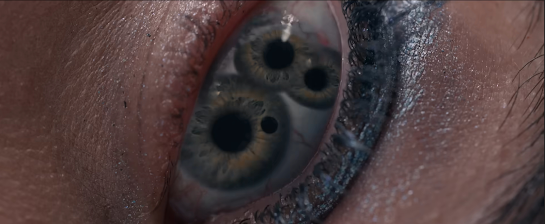
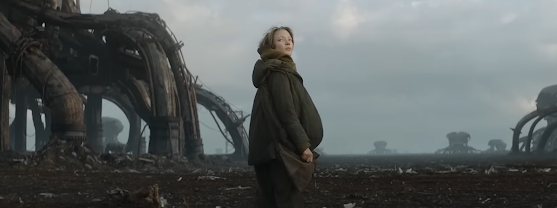
 Vesper embraces the genre with gusto. A crashed ornithopter-like vehicle sheds a trail of organic parts as it goes down, generators run on cultures of bacteria, drone repair looks like a deleted scene from Videodrome, and so on. It's a bit too fantastic to register as proper hard scifi, unfortunately (too many things seem either too far-fetched or too nonsensical) but the world is lovingly rendered with a lot of imagination, detail and texture.

 It's set at some point in a future where biotechnology run amok has wrecked the ecosystem. Animals as we know them are gone, trees sport meaty, cancerous growths, there's weeds that shoot weird insectile missiles (remember what I said about the 'science' being a bit too silly?) and so on; the film does a great job at portraying a world that's been completely remade. Enclosed Citadels house the high castes of the world, who live in relative luxury while people outside survive how they can - and one of the ways they maintain their power is by selling seeds that have been genetically locked so that they only last a generation (utopia, as designed by Monsanto/Cargill.)

 13-year-old Vesper (Raffiella Chapman) wasn't born on a Citadel. She lives alone in a small house with her invalid father (the great character actor Richard Brake) who is bed-bound but often accompanies her via a remote-control floating drone; her life consists of foraging in the mud for edibles and weird plants to run her biotech experiments on, and occasionally trading with neighboring creep Jonas (Eddie Marsan), who runs a cultish compound close to her house.
 After a leisurely first act introducing Vesper and her world, the movie coalesces around two events and their consequences: First, Vesper is forced to steal some valuable supplies from Jonas. Then she sees a crashing flying vehicle and rescues one of its passengers (Rosy McEwen.)
 The Passenger, Camelia, is a Citadel resident, and she promises Vesper access to it if she helps her out with a few tasks. The rest of the story has to do with their tentative friendship, and the escalating sets of complications Vesper's actions and Camelia's just being there brings for everyone involved.

 The movie feels a bit like a young adult yarn at times, and that's not helped at all by using the tired old 'girl genius' trope (Vesper, you see, happens to be an absolute wiz at biotech hacking!) It's a french young adult yarn, though, so it leans extra cruel with a discomfiting side of sexual menace.
 It gets pretty dark; not overwhelmingly so, but this is the sort of movie that unceremoniously kills of important characters and is happy to deny the more traditional payoffs you'd expect out of this sort of thing.

 The pacing is sedate at first, but soon it ratchets up the tension as you wait for the other shoe(s) to drop. It also does surprise with some tense action, not incredibly ambitious but well staged.

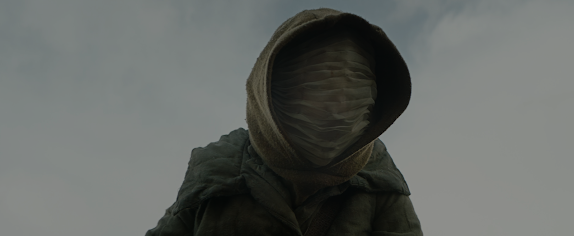
 All the actors are good. Chapman is fierce and committed, and Marsan gives a great, sleazy performance that makes for a very hiss-worthy villain, especially once things get serious and he lets his freak flag fly. It's a low-budget movie but it's got an interesting aesthetic going on with a lot of light/shadow contrast (people who hate washed-out looks and dark cinematography may want to sit this one out). The effects are pretty good and imaginative, and I especially liked the wardrobe design; there are some really good-looking, original costumes on display:

Full-face facemask


Full-body hood (over an actual hood!)

 It's a good one.