Saturday, March 09, 2024

One Shot

 One shot is a simple indie meat-and-potatoes military action movie with one flourish: it's shot in a (simulated) one take chronicling a very busy ninety-something minutes at a CIA blacksite prison island.
 A SEAL team led by Jake Harris (Scott Adkins!) is charged with escorting a CIA analyst (Ashley Greene) to retrieve Amin Mansur (Waleed Elgadi), a high-value prisoner who apparently holds information that might help avert another 9/11. They get held up by some bureaucratic back and forth, and just as they manage to take custody of the prisoner, a (literal!) truckload of mercenaries arrive, blow up the SEAL's extraction helicopter and start shooting up the place. Of course they've come after Mansur, too.

 The SEAL team and their wards hole up in one of the buildings while the mercenaries kill off most of the troops outside and free and arm the other prisoners. As the defenders run out of ammo, Harris makes an excursion out to fix communications. There's some infighting, as you'd expect, and an interesting tangent where Mansur insists that he's innocent - a victim of the war on terror - which adds a little unpredictability to the proceeds, but in the end it's not really important except to make him into an unexpectedly sympathetic figure. It's one of those movies where anyone can go at any minute, and things get remarkably bleak.


 The constant long takes mean that it sacrifices complexity to gain immediacy - the action consists of mostly pretty straightforward shooting and cat-and-mouse games, always moving relentlessly forwards. It gets a little exhausting, and seems to run out of steam as it carries on; Personally, I'd rather have a more traditional film where the choreographers don't need to worry about a botched move ruining a seven minute take - that way they could plan more elaborate action, but this works just fine.
 Compounding the issues with the action sort of running together, the military compound doesn't make for a very engaging backdrop - it's barely a step up above abandoned warehouse - but I guess it's pretty low-budget-friendly.

 The script (by Jamie Russell) is very simple; Dialogue's a bit hoary, but it fits its subjects. The fact that they're in a black site is treated very matter-of-factly; everyone is aware of it, knows what happens in them, deals. There's no overt ideology espoused here, and that's probably the best tack as it's really not what the movie is about. The film doesn't shy away from showing human rights violations, however, and the CIA analyst takes a dim view on the viability of torture (and is later proven right). So a little ideology seeps through.
 A couple of villains are provided (played by Jess Liaudin and Lee Charles), and the action does follow them for a while, but other than show that they're only in it of the money and use 'the cause' for profit, they're not very strong characters. Suitably badass and menacing, but not really memorable.

 Technically, it's a very accomplished film. Nothing as elaborate as, say, 1917, but then again, even though the budget here is the tiniest fraction of that, the takes seem to be a bit more seamless, and I only noticed a couple of the hidden cuts. Much respect for editor Liviu Jipescu. Despite the 'one shot' gimmick, director James Nunn counterintuitively plays down the technical aspects- it certainly doesn't really have any moments when it shows off. They could do it, just a little; they earned it.
 The low budget is noticeable and, as mentioned before, the action gets a bit samey, but its momentum is strong, and it's such an uphill battle that it remains engrossing until the end.

 Adkins doesn't really get a chance to show off his martial arts - it's not that type of movie, anyways - but he's very believable as a gruff, hyper-competent SEAL (says a guy with no experience in anything even remotely military), and his physicality and precise movements lend what brawls there are, and even all the running and gunning and cover-taking, a welcome edge. He's great, even if his main strengths go untapped.
 The rest of the acting is all over the place - Ryan Phillippe was especially unconvincing as a hard-ass superior officer - Or maybe miscast, I have a lot of trouble seeing him as a hard-ass anything. 
  Music comes courtesy of prolific videogame composer Austin Wintory. It's non-diegetic and also not his best work. The cinematography (by Jonathan Iles) is exactly what you'd expect: all muted colours, and the whole one-shot gimmick prevents it from doing much of interest. Some of the explosions are pretty dodgy CGI, but nothing immersion breaking.
 It's all right. A fun B-movie, and its style is both well-executed and provides the film with a distinctive hook it'd otherwise lack. I might not remember anything about it in a couple of years, but I enjoyed watching it.
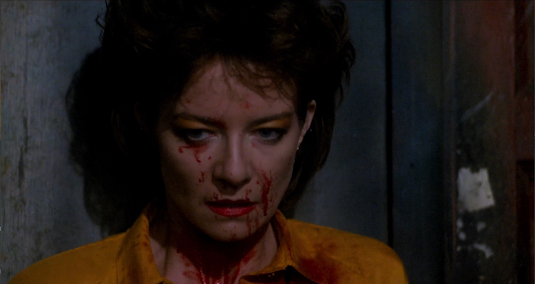
Hellraiser

 It's hard to overstate how hard Hellraiser hit back when it came out.
 1987 had an unusually good crop of future cult horror movies: The Hidden, Evil Dead II, Bad Taste, Monster Squad, Near Dark... and that's not even counting more mainstream stuff like Dream Warriors or The Lost Boys. But even compared to that batch of instant classics, Hellraiser was something else - nastier, sleazier, just plain weirder. Its gore is not quite as shocking now as it was back then, but everything around it is every bit as freaky.

 What's sometimes easy to forget is that for all its perversion, gore and cosmic horror, it's a complex, solidly constructed movie, full of wit and (black) humor. Clive Barker adapted his own novella, The Hellbound Heart, which was a natural fit for a feature thanks to its length and relative simplicity. The bones of the book ground it well.

When Larry (Andrew Robinson) and Julia (Claire Higgins) Cotton move back to Larry's family home, they're unaware that Larry's brother Frank (Sean Chapman/Oliver Smith) is still residing there.
 Frank was an... explorer, you might say, in the further regions of experience. Which is a fancy way of saying he was a pervert so jaded he summoned a bunch of S&M pervert demons just for kicks. That, predictably, didn't end well for poor, dumb, horny Frank, and the demons - better known as cenobites - left what little remained of him after they were done under the floorboards of the room he called them in.
 Now I think of it, they did a great job tidying up after themselves; pretty considerate for a bunch of degenerates from another dimension.

 Anyhow! During the move Larry cuts his hand on an exposed nail (ouch!), and his blood splashes (literally - there's a lot of blood) on the floor just above where Frank's remains were figuratively swept under the carpet. Sure enough, this unwitting sacrifice eventually resurrects Frank from the bones up in an amazing and disgustingly gooey scene. With such a pittance of blood, though, Frank comes back as a wretch, a wet rag of a pitiful zombie. Luckily for him it's Julia who discovers him; It turns out that she and Frank had a torrid affair right after she married Larry, and she's never quite forgotten him. Her horniness for Frank, coupled with the film's hilarious insistence on portraying poor Larry as a complete wuss, makes her agree to Frank's request to bring him more blood so he can finish regenerating and put some damn skin on.

 Julia is such an incredible character; a very posh, very British, extremely 80's ice queen that nonetheless displays some real vulnerability when she seduces some poor soul to murder him on Frank's behalf. You can almost see her wondering if maybe it's wrong to lure people to the house and kill them so her undead squeeze can live again...
 And then the victim starts behaving like a douchebag and she steels her expression: No, there's nothing wrong with hammering some asshole's brains out. Just like that, you get a nice streak of gallows humor to an already complex scene. Amazing.

 All of this takes place right under Larry's nose, but he's way too much of an idiot to ever notice anything. It's his daughter from a previous marriage, Kirsty (Ashley Laurence) who pieces the clues together, figures what's going on, and inadvertently summons the Cenobites back again for a grand three-way confrontation. She's a fun, resourceful protagonist, but I'm sorry lady, you've got nothing on your stepmom. Neither does Frank, now I think about it; He makes for a remarkably sleazy villain, and is a lot of fun to watch strutting around like an illustration on a medical journal or staining a white shirt pink, but in the end it's all about Julia.
 Julia and the Cenobites.

 For a movie that launched Pinhead the Cenobite to instant fame - a horror icon to rival Freddy Krueger or Jason Vorhees, if not Dracula or any of the elder statesmen of horror - he's not on-screen all that much. His continued pop-culture success was down to a lot of work and talent: an incredible design and makeup job (Bob Keen and Geoff Portass did makeup and Jocelyn James costuming - all worked from a basic design from Barker), coupled with Doug Jones' dour, sanctimonious turn under the mask. His delivery of Barker's endlessly quotable, deliciously lurid dialog is extremely memorable ("No tears, please - it's a waste of good suffering.").  Remember, this was before comic book movies were popular, these sort of flowery, poetic/cheesy lines were not that common outside of fantasy movies.

 None of his hellish colleagues get a lot of love - two of them couldn't speak with all that makeup on, so their lines were reassigned. Open tracheotomy lady is cool, and so is the chatterer - both incorporate the movie's lines and hooks aesthetic into their design. The fat one, though... come on, he's just funny.
 I should also give special mention to the puzzle box, the device by which the cenobites are summoned. It's such a perfect storm of incredible art-deco-like prop design and a cool concept, seamlessly integrated into the plot... no wonder it's just as iconic as Pinhead.
 It's a shame these elements completely overshadow the pervy psychodrama at the heart of the story, but I guess it's also understandable. These are some prime quality elements.

 And then, of course, we have Barker's showmanship and penchant for weirdness. There's a couple of cool monsters that don't seem to be cenobites, just some weird hellish fauna that chase Kirsty for a while and provide some memorable imagery at the tail end of the film - I mean, who am I to say no to a demonic skeleton dragon?

 There are some issues with the acting, which sometimes gets a little soap-opera-ish, and some noticeable dubbing (apparently the film is meant to take place in the US, though I always thought it was set in the UK - I think my interpretation is valid, and the house is so British that I'd struggle accepting the official one). The film sometimes strains against its budget, especially when it gets more effects driven near the end, and Kirsty's love interest is completely superfluous (other than to show that no, she's no virginal figure; Everyone fucks/is horny/is a pervert in this movie).
 All these are fairly small issues, even smaller when set against everything that the movie gets so perfectly right - I haven't even mentioned Robin Vidgeon's excellent, evocative cinematography, or Christopher Young's amazing score, which contains one of the greatest and most recognizable horror themes of all time.

 What else can I say? I love this movie; It was hugely formative for me, for better or worse, and I'll always think of  it as one of the greats.

Friday, March 08, 2024

UFO Sweden

 Denise (Inez Dahl Torhaug) is a troubled young woman whose UFO-obsessed dad disappeared while she was very young. And because this is a very specific type of movie, running through a series of foster homes means that she of course grows up to be a John Connor-style teen delinquent who's a wiz with computers: she's even introduced hacking a keypad with a modified gameboy.

 When her father's car somehow reappears, crashing into some farmer's barn in the middle of the night, she contacts UFO Sweden - a bunch of middle-aged nerds/UFO enthusiasts - to try and make sense of what's happening. And as it turns out, the government is... well, not in on it, exactly - it's never quite clear what anyone is doing in this movie - but there's a lady in meteorological services who seems to be tracking gravity disturbances, data that Denise recovers and uses to zero in on just what happened to her father all those years ago.
 With the conspiracy angle a complete mess, the movie is left needing some antagonists. This void is filled by a well-meaning police officer (Sara Shirpey) who gets it into her head that UFO Sweden is some sort of cult, and a turncoat within UFO Sweden who just doesn't seem to like Denise much and so decides to become evil as a result. Hey, I didn't say that there'd be good antagonists.


 The script - by director Victor Danell and Jimmy Nivrén Olsson - is piss-poor, stringing some dire science fiction conceits along a series of terrible, terrible decisions, arbitrary developments and inscrutable motivations. Events don't really make much sense as presented, and its characters don't come out looking great, either; Just how UFO Sweden ends up rallying behind Denise, for example, is a mystery, given how she tends to behave like a little shit and only acts nice when she needs something out of them. But, you know, she's the protagonist, so not only does that shit fly, I think it's supposed to be relatable?
 It reeks of script improvisation or extreme tinkering right up to the point where the cameras started rolling. 

 However, while the filmmaking is not truly great, it's very muscular and features some pretty excellent chases, car crashes, a couple of interesting special effect sequences and a few instances of great comedic timing. The acting is also good, with a well-developed central relationship between Denise and Lennart (Jesper Barkselius), leader of UFO Sweden and an old friend of her dad's. Most importantly, it sticks the landing with a strong emotional scene that capitalizes on all the good work Torhaug and Barkselius put in throughout the movie.
 And while the music (by Oskar Sollenberg and Gustaf Spetz) consists of the expected sci-fi synths, they're lovely sci-fi synths.

 Whether you'll like it or not will depend on your tolerance for the iffy script, and if you can be bought over by the film's surfaces; Despite a long runtime for what it is, it doesn't really drag too much, and there's always enough going on even if it doesn't make sense all that often. It's not actually a good movie - within this space, I'd direct you towards Jeff Nichol's Midnight Special for that - but... I don't know; While I rolled my eyes a lot during its runtime, a good ending can retroactively enhance any movie. It's all right.

Thursday, March 07, 2024

Dawn Breaks Behind the Eyes

 Half psychodrama, half 60's/early 70's sleazy euro-horror, half surrealist, psychedelic freakout... Dawn Breaks Behind the Eyes is a movie of many, many halves, most of them good, all fused together with a huge amount of style.


 Eva (Luisa Taraz) and Dieter (Frederik von Lüttichau) are an unhappily wedded couple. They're visiting a castle Eva inherited from her rich family, with Dieter complaining bitterly about how they never get any real money from them; Eva is the artistic, pensive one while Dieter is brash, whiny and resentful. They talk at each other, not to each other, unwilling to engage.
 As their mutual loathing becomes more and more apparent, both of them have separate, seemingly supernatural experiences with other people in the castle. Things come to a head with a gleefully over-the top bit of gore which literalizes some of the movie's themes, and then the film suddenly pulls out the rug out from you, introducing a separate couple played by Anna Platen and Jeff Wilbusch, and a load more characters besides (which never get to be more than background color).

 It's an intoxicatingly rich movie, with gorgeous visuals and a well-written script that might not cohere narratively but weaves its themes tightly. Director (and co-writer, along with Lilli Villányi) Kevin Kopacka is not nearly as worried about plot as he is by texture and about examining his characters' relationship from multiple angles, something he achieves by repeatedly switching tacks as reality is seemingly rewritten.
 Where he arrives is not ultimately important, though the 'explanation', when it arrives, is more coherent and satisfying than I thought it'd be. Interpretation is key here, and the script seems uninterested in providing any clear answers. Ultimately it's not so much a horror movie as a supernatural puzzle we're not meant to solve, just to poke at.

 For all its memorable imagery, there's just one bright red punctuation mark of a gore scene which is quickly recontextualized, and all the genre elements are more surreal than true horror. It's an easy movie to recommend to anyone who's watched any, say, Mario Bava but it's harder to say what someone who's unfamiliar with its influences might say. I'd recommend it anyways if you're feeling adventurous: It's only seventy-something minutes long, it oozes effortless cool, and it's got the most fun end credits I've seen in a long time.

It Lives Inside

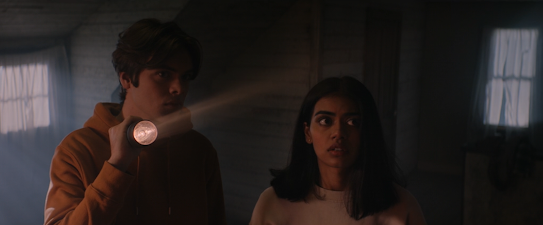
 Samidha (Megan Suri) has been drifting away from her Hindi heritage. A second-generation Indian emigré teen living in the American suburbs, she can't but help to want to develop her own identity, one closer to her social life at high school as opposed to the one she feels her family is forcing on her. It's the sort of natural and (very) mild act of rebellion that would normally only provide some temporary drama with her family - time, as always, would allow them to reach some sort of balance.
 But this being a very square, teen-oriented horror movie, it leads to a demon trying to eat her instead. Other movies have people killed for having premarital sex, this one puts the protagonist in danger for not speaking Hindi at home or spending the day cooking with her mom.

 It starts with an old, estranged friend, Tamira (Mohana Krishnan), following her around at school in an almost comically creepy fashion, clutching a jar as if her life depended on it. To subtly drive home the movie's themes, we learn that Samidha cruelly ditched her former nice, Indian BFF to fit in better with her new white friends.
 Things come to head when Tamira finally confronts Sam, trying to enlist her help in fighting some sort of entity she insists is trapped in her jar. They struggle, and the jar ends up in pieces on the floor.


 Tamira disappears later that day, and the creepy entity starts following Sam around. Here starts the most enjoyable part of the movie, as she follows the clues left in one of those creepily-illustrated horror movie journals (good thing demons always seem to target artistically-inclined kids first so they can provide some cool artwork to the proceeds) accompanied by some effective, if derivative, supernatural scares.
 It doesn't last, though, and the second act comes to an end with a demon attack set in a swing set that's so ridiculous and unwittingly funny that the movie - which was already on thin ice - never really recovers from it. The demon becomes emboldened afterwards and makes its attacks more overt, which is good because it's a very cool creature design. Unfortunately writer/director Bishal Dutta and his crew botch every single horror scene, and compound on the problems with some very predictable story beats and a defanged, strictly-PG13 ethos.

 It's not a terrible movie -though it does have some pretty bad moments, but it is kind of mediocre: an uninspired teen horror movie - the sort of shit I make fun of Blumhouse for constantly putting out. A shame, because it wastes a promising premise, good acting, decent, atmospheric cinematography and a great monster.
 Its laughably square* message would be a hard sell even if it had a smidgen of nuance to the characters - instead we get things like Sam's mom (Neeru Bajwa) completely failing to even try to engage with her daughter until she comes begging for help with something only tradition can help with - a sour note to their supposedly warm rapprochement later on in the movie.
 Granted, its unambitious teen leanings meant that this was never really going to be for me, but I think it's not very good for what it is either.


*: How square is it? I mean, beyond the whole mommy knows best angle? Let me communicate it by the medium of SPOILERS: The only person who dies in the whole fucking movie is an otherwise nice-seeming dude who (very, very politely!) offers Sam a joint. Screw this noise.

Tuesday, March 05, 2024

Pyewacket

 Here's some trivia for you: Pyewacket was the name 'extracted' from a poor woman as one of her familiars by the self-proclaimed witchfinder general (and all-round sleazebag) Matthew Hopkins. I was pretty proud to have caught the reference, but of course it's the third google entry when you search for the name, right under the two entries for this film. You can't one-up the internet.

 Pywacket (film) is a very solid indie Canadian horror/drama about a teenager who summons a demon in a fit of rage. Yeah, that always works out.
 The teenager is Leah (Nicole Muñoz), a goth/metal girl whose backpack sports Carach Angren, HIM and Ministry patches - way to cover all bases! She's into the occult, because of course she is, and one early outing in the movie with her friends is to a book signing by some sort of paranormal expert who may or may not provide demon-wrangling counselling later on. They later discuss the book in an appropriately pretentious manner.
 I actually really liked the movie's portrayal of Leah and her friends: They listen to poppy techno and Lords of the New Church - it might not be very authentic (you'd think at that age they'd be a lot more self-conscious about what they listen to), but it underlines that they're well adjusted and basically seem like happy kids. There's no bullying from the outside, they (well, with one exception) genuinely care about each other and there's only the mildest of internecine drama, at least until the supernatural intrudes.
 Canadian cliques seem to be a lot more wholesome than their American counterparts.


 But while her social life is pretty good, Leah is Going Through Shit. Her dad's died recently, and her mother (Laurie Holden) is introduced as a wreck, drinking and crying all the time. I was a bit worried about that at the beginning -she screeches into the film like a belligerent, one-note harridan- but writer/director Adam MacDonald wisely eases back on confrontation, letting Leah's character deal with her in a much calmer manner than you'd expect from a movie teen.
 The drama gets a tiny bit strident at times, but it's well observed and shows a lot of humanity.

 So Leah seems to be holding things together... until her mom drops the bomb: she's sold the house, and they're moving to a house in the middle of nowhere a two hour's drive away.
 After a few more confrontations with her mother, Leah has enough, digs up her occult manuals and performs a (pretty cool) ritual that's somewhere between Wicca and the lesser key of Solomon to call upon an entity named Pyewacket to kill her mom.

 And then... not a lot continues to happen. There's a couple of effectively creepy scenes as... something makes itself known, but the most important development is that Leah's mom, mortified by some of the things she's said (and worried her daughter is doing self-harm due to her ritual injury) scales back on the aggression and they manage to patch up the relationship. Oops!

 There's some scares, of course, including an excellent incident with Leah's BFF (Chloe Rose), but this is an extremely slow burn, a very simple story that prioritizes drama over supernatural mayhem until the very last fifteen minutes. And that's fine, because the characters are great, the naturalistic script still finds  the time to imply a sense of creepy menace off in the wings, and Muñoz easily carries the film with a very sensitive, internal performance. And yeah, it does work its way to a memorably evil ending. Don't fuck with demons, y'all.

 The filmmaking is great, with a lot of handheld camera work that complements the material well - and at one point a cool Evil Dead forest flyby to imply whatever was woken has definitely not gone back to sleep. The scenery is fantastic, all autumnal Canadian forests, giving the film a naturally limited palette.
 I'm not a fan of the trope that the protagonist got into the occult because her dad died - couldn't she just think it's cool, like 99% of nerds everywhere? But if that's one of your biggest complaints in a movie, it counts as a stealth compliment. I also immediately assumed Leah and her friends were on the more adult side of the teen years, and the script works a lot better if you tweak that down until they're fifteen or so. Despite the casting, it's an easy mental adjustment to make.

 Niggles aside, this one's pretty good. Just know that it's more on the quiet side than the trailer lets on.

Monday, March 04, 2024

As the Gods Will (Kamisama no iu tôri)

  You can't be prolific and consistent; That's just common sense. And when you're as insanely prolific as Takashi Miike... well, you're definitely going to have some turds composting in between the folds of your bloated filmography. To reach those sort of numbers, you simply can't give a fuck about what you're making a lot of the time.
 If Blade of the Immortal was Miike's 100th film, then by my count As the Gods Will was his 94th - the second and final film he made on 2014. And it is an absolute stinker.

 Shun (Sôta Fukushi) is a whiny piece of shit of a high-schooler, one of those insufferable "woe is me, my life is so boooooring" pieces of shit characters that's got not one but two beautiful girls pining for him*. So of course he gets a sort of supernatural intervention, in the form a group of sentient toys that hijack all the high schools in the world and force the students in them to play children's games... to the death.
 It actually starts out pretty promising! Juvenile, sure, but it opens up in media res, with a bunch of students up to their ankles in beheaded classmates, and cuts back and forth in a pretty engaging way until it's clear that an animated daruma doll popped out of a teacher's head and is now playing red light, green light with the kids - and if it catches anyone of them moving, their heads explode in a shower of blood and red marbles.

I give this movie one finger out of ten. Doesn't even deserve two.

 But as soon as we're all caught up, the kids start talking and the script (by Hiroyuki Yatsu) rears its misshapen, incompetent head. It's based on a Manga by Muneyuki Kaneshiro and Akeji Fujimura, and holy fuck is that ever obvious; all the typical bottom-of-the-barrel formulaic manga stench wafts out and immediately overpowers anything else, voiding any chance that this could ever be any good; Constant pauses (...), people just muttering each other's names and constantly explaining what just happened to each other, tropes instead of characters, screaming, cheap melodrama. Plot holes, constant dramatic emphasis, bullshit philosophies and folks acting in deeply stupid ways to 'enhance' the drama. Fuck. This. Shit.
 Plotwise, Shun keeps making it through increasingly bizarre, deadly games (shooting hoops with a giant good luck cat statue, playing werewolf with an extreme snowboarding bear) and running into fellow high-school survivors - two love interests (Shoko Takase and Hirona Yamazaki) and Takeru (Ryunosuke Kamiki), your stereotypical anime psycho. But honestly, the only game that holds interest is the first one. While things do get admirably ridiculous now and again - you can see why this, on paper, would have caught Miike's eye - unfortunately it's all diminishing returns after that first game.

 This might call to mind Squid Games, but... honestly? It's just more tripe in the vein of Battle Royale (a movie I personally kind of despise, but is still miles better than this) - teens forced to kill each other to arbitrary and bizarre rules equals easy symbolism without the need to have anything to say; let the critics and viewers fall over each other to say it for you.

 Worst of all is that Miike is on full professional mode and shows way too much restraint by only implying most of the carnage, or diluting it with magical realist touches like the red marbles at the beginning (which, to be honest, was pretty cool; it's the only good one, though). Dammit, I want to see those pieces of shit get carved into smaller pieces of shit; Here, when someone gets a deadly case of the splits, we never see flesh tearing or get to linger on the aftermath- just a glimpse of a little blood pooling. This, from the guy who brought us Ichi the Killer! Who the fuck thought it'd be a good idea to hobble him with the Japanese equivalent of a PG13 rating?

 It's not a complete complete waste of time. There's flashes of fun every now and then, some amusing cruelty, and the material brings out a little of Miike's anarchic spirit every now and then. The X-TREME polar bear is funny. Not enough - not even nearly enough to justify watching the whole thing, though.
 I'm sure it's not even near the bottom of this director's films quality-wise - I've only seen, at a guess, twenty or so, and the very worst probably never made it out of Japan. But it definitely is the worst one of his I've seen, and I really wouldn't want to see him doing worse than this turgid, bloated (almost two hours!), inane, fucking stupid pile of reheated, anime tropes that were never above piss-poor to begin with.


*: Also, he sucks at Resident Evil 6, and by extension sucks at choosing Resident Evil games. Fuck that dude.

Duel to the Death

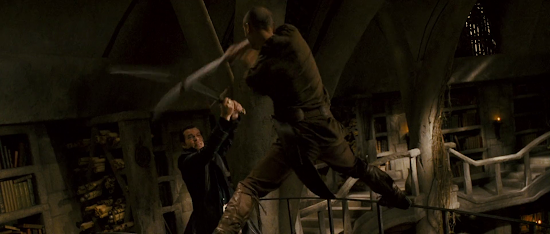
 Germany has stolen one of Hong Kong's great treasures, Ching Siu-tung, and has used him to commit great mediocrity by handing him over to Uwe Boll. Honor demands a duel between reviews; If I felt like being fair I'd choose something like Belly of the Beast for it to go against, but it's been a really long time since I've felt like rewatching any Seagal. So I'll go with the utterly amazing Duel to the Death from 1983.

 How cool is Duel to the Death? In one of the climactic fights, someone jumps out of his clothes, leaving them standing there as he ascends to the treetops. Then his head gets chopped off, flies off and gets impaled on a twig; It still has time to deliver a badass ultimatum before it fucking explodes.
 And that's it: Just a few fragments from a (much longer and full of just as awesome bits) scene and honor is restituted. It was never even a contest.

 I always feel a little apprehensive when reapproaching movies I haven't seen in years, especially ones I loved as a kid. Shouldn't have worried, though - I'm happy to report Duel to the Death is just as delightful as it ever was, a beautifully shot Wuxia epic that splits the difference between ridiculous and stately by adding extremely over-the-top dastardly ninjas to a more grounded martial arts contest for honor between Japan and China.

 The ninjas are introduced right from the get-go, infiltrating a Shaolin monastery and stealing some scrolls (I guess data theft was already a thing back then) before the monks discover them and a fight ensues. Things end up with them turning into suicide bombers, limbs flying everywhere... you know, fun before the terrorists ruined it for everyone.

 After this prologue we get a Japanese diplomat (Eddy Ko) on an official visit to the same temple. There he insults the monk's honour until they agree to set up a duel (to the death) between Japan's champion and China's. China's champion, Ching Wan, is played by none other than Damian Lau, while Japan's champion, Hashimoto, is played by Norman Chui.
 Ching Wan is easy-going and pleasant, Hashimoto is intense, honorable, and driven. The Chinese are constantly going on about how there may be time for a peaceful resolution, the Japanese are murderous and bloodthirsty; This is not a movie that paints the Japanese in a very favorable light, with Hashimoto as the sole honorable exception. There's a reason why all the Japanese are portrayed by Chinese actors, I guess.

 As the protagonists reach the venue for the fight - an ancient, discredited sword school run by an old master (Paul Chang Chung) and his beautiful daughter (Flora Cheong-Leen), a plot is revealed to use the duel as cover for an in my opinion pretty dishonorable ploy to humiliate China and steal their Kung-Fu secrets. It gets a little more complicated later as some corrupt Chinese accomplices are introduced, but yeah... this probably didn't play well in Japan.

 It's a busy movie, and unfortunately the storytelling is all over the place, but the plot is satisfying right up to a beautiful, ambiguous final shot. Both Ching Wan and Hashimoto are great characters, and though the often silly ninja hijinx clash a little with the (slightly) more naturalistic duel storyline, the more fantastic stuff is highly entertaining, imaginative and well-made. There are so many cool stunts and ideas in this movie: people use their swords to effectively double-jump, ninjas joining together Voltron-like into a bigger ninja, and falling leaves used as cover for a shower of shuriken. It's a little gory, too, with quite a few dismemberments, but nothing too graphic.

 The fighting covers all bases, from more natural melee to mid-air fights that look like aerial juggles from fighting videogames. Almost all of the action involves weapons of some sort, and it's all very well directed and exciting even if the editing gets a little too excited every now and then. While the script (by the director along with David Lai and Manfred Wong) is... well, uneven, and probably won't convert anyone who's not already on-board with Chinese martial art movie conventions, it's wildly imaginative and full of good lines, cool character developments, and fun asides. I like it a lot, and it seems to me to be a cut above in quality to most other martial art epic scripts.
 It's also a very, very beautiful movie, with plenty of great scenery - cinematographers Danny Lee and Lau Hung-chuen do a great job of setting up a lot of varied, interesting venues for the action to take place in, their imagery crisp and very colorful. The blu-ray transfer looks amazing.

 Yeah, this is a stone-cold classic. I haven't been a huge fan of more recent Ching Siu-tung movies I've seen, even the ones not directed by Uwe Boll or starring Steven Seagal, but I really need to get around to the rest of them soon.

Friday, March 01, 2024

Dune: Part 2

 The Dune books were always just as much about the grand designs and conspiracies of the powerful as they were about the pulpy adventures of its heroes; In fact, those plucky protagonists start out as victims of these machinations, and their journey is to turn into Machiavellian machinators in their own right. It's a complex, thorny saga that doesn't really have a lot of faith in humanity.

 That's something that seems to have resonated with director/co-writer Dennis Villeneuve. Despite having all the trappings of an (artsy) action/adventure sci-fi movie, this is a bleak, fatalistic fantasy.

 After the events of Part 1, Paul Atreides (Timothée Chalamet) and his mother Jessica (Rebecca Ferguson) have narrowly escaped the destruction of their house at the hands of the gleefully psychotic Harkonnen. They are taken in by Stilgar (Javier Bardem), a chieftain of one of the desert tribes of Arrakis, the Fremen.
 Paul humbly joins the tribe, asking only to learn their ways, while Jessica is recognized as a "witch", part of the order of the Benne Gesserit, and inducted as reverend mother of the local order.

 Paul takes on a Fremen name (Muad'dib) and gets to go on adventures harassing Harkonnen spice operations and romancing Chani (Zendaya), a Fremen warrior only seen in visions in the first movie but with a fairly juicy role this time around; Their courtship is pretty sweet - it includes her teaching him sandwalking, which looks like they're doing a synchronized re-enactment of Monty Python's Ministry of Silly Walks skit. She (and her friend) also seem like the only one who's having fun in the movie. Well, she and her friend and Stilgar, who gets a lot of wryly funny lines.

FUCK YEAH.

 While Paul is having fun playing soldier in the sand, Jessica goes to the planet's "uninhabitable" southern hemisphere, where all the religious fundamentalists hang out, to lay out the groundwork for a holy war. Yes, the movie goes out further into fantasy land than the book; But it gives the Fremen some welcome complexity; the northeners look down on their fundie cousins, making fun of them for believing in prophecies.

 The Harkonnen eventually get tired of this new rabble rouser throwing sand (sorry) into their spice-harvesting machinery, and in an absolutely stunning near-monochromatic interlude set in the Harkonnen home planet, they arrange for another scion of the house to go down to Dune to impose some order: Feyd-Rautha (Austin Butler), famously played by Sting in the 1984 edition. His brutal oppression will lead Paul to make some harsh choices.

 It wouldn't be Dune without an extra dozen characters to introduce, so the story expands to include the emperor (Christopher Walken) and his heir (Florence Pugh) and their reaction to this hiccup in spice production.

 The script (by Villeneuve and Jon Spaiths - Eric Roth seems to have fallen by the wayside) has a lot of ground to cover, and moves at a fair clip; That, coupled with its complexity meant that I was always engaged and never felt it drag. And yes, now there's a payoff, it retroactively 'fixes' the pacing and structural problems of the first movie.
 And holy shitballs have they ever stepped up on the visual department. Part One is no slouch on that front, but this film has multiple scenes that had me smiling like an idiot. Villeneuve still hasn't completely cracked how to make exciting action (the swordfights are better this time around, better choreographed), but the level of spectacle on display, and the trippy, imaginative visuals are second to none. None. The scale of some of those things!
 Hans Zimmer's score is still excellent, and this time around it didn't hurt my ears - I'll reserve my opinion on the sound mix until I can watch it on home video at a lower volume, but I suspect it's all right now.

 It also remains fairly faithful to the source material, though less so than the first part. Paul's sister remains unborn here, which was a little disappointing as it was always one of the novel's wackier elements; I'd have loved to see it rendered in these movies' overtly serious style. Instead we get Jessica wandering around whispering like a madwoman to her womb, which is a pretty good consolation prize. A little Prevenge in the year's biggest blockbuster so far.
 Oh, and Chani is no longer the non-entity she was in the books, eventually becoming somewhat of a conscientious objector here, and it adds to the attempts to make the Fremen be a little complex here, and to Paul's journey. I liked that change.
A few other things were changed (that I noticed), but all in all it seems to me that the spirit of the novel remains unchanged.


 Does it have issues? Well, yes, because nothing is perfect except maybe Braindead. Or, closer to home, Arrival.
 I don't mind that it's not really science fiction - that battle was lost sixty years ago, for fuck's sake, move on - but I have a *lot* of conceptual issues with the technologies and tactics on display. The personal shields remain as protective as being wrapped in wet napkins, and surveillance seems to be non-existent (thousands upon thousands sneak up on a capital city without anyone noticing - I know they're desert power or whatever, but come the fuck on).
 There's a whole engagement where ground forces attack a spice harvester that's easily resolved by a laser (which remain hugely overpowered in these movies) slicing the whole thing in half in seconds. Why bother sending ground troops in the first place? And so on; it's all forgivable, but I wouldn't begrudge someone for taking offense at these things - lesser problems have sunk whole movies for me, after all.

 Those are minor niggles. My greatest issue is that, despite giving in and falling into the cadence of an action movie, Villeneuve seemingly remains uninterested in providing an action movie; Many of the beats in the final stretch - especially the final battles - feel oddly curtailed, perfunctory, even when they're providing the sort of cathartic resolution you'd expect. At least they nailed the fight with Feyd, that was pretty good.
 Yes, I know making the action exciting might dilute the message, but come on - might as well go the whole mile to get to your cake and eat it. Or something. Maybe the movie was too long already, but then there were definitely other aspects of the film that could have been tightened to let the action breathe a little more; Leave the finer details for the extended editions. Oh well.

 It feels really petty to complain about such a wealth of awesome stuff, though; It's staggeringly good, and on a pure spectacle level, it puts pretty much anything else to shame. Bring on Messiah of Dune, I can't wait to watch Timothée staggering around the desert in a drugged-out haze for two hours. As long as it looks half this good, I won't complain.

Thursday, February 29, 2024

Dragon Lord

 Dragon Lord is another movie Jackie Chan made for Golden Harvest in the early eighties. It was originally going to be a sequel to 1980's The Young Master, with Chan reprising the main character from that. That plan was scrapped, but the character is still called Dragon, and the movie is somewhat similar in form and content, if not as focused.

I love this shot - note the looming shadow of the villain.

 Set in in late nineteenth century China, Dragon (Jackie Chan) and Chin (Mars) are two aristocratic dipshits who basically behave as if they were nine years old, getting up to all sorts of mischief; Usually in pursuit of girls. Despite having some phenomenal action sequences, this is more a comedy than a martial arts movie... which is not great, as the humor is as usual extremely broad and corny. Your mileage may vary, of course.

 In between trying to one-up Chin to impress a local woman and staging elaborate academic cheating methods to impress his father, Dragon manages to interfere with a smuggling operation by a rogue army battalion (I think) led by... I guess the only name we're given for him is The Big Boss. He's played by Hwang In-Shik, who was also in The Young Master, again inhabiting a supremely badass villain - moreso here, as he displays honor and forbearance throughout; He only appears in a few scenes, but he handily steals the film from under the ostensible protagonists.

 The extremely basic plot is colored in with all sorts of digressions, most of them comedic. There are two extended action setpieces that are basically sport matches - one a sort of four-team rugby match at a bun festival where the ball needs to be retrieved from a teetering mountain of bamboo poles and buns (which, of course, topples spectacularly as the contestants climb over each other to get to the top). The other one is a Jianzi match, a game that's similar to football except the ball is replaced with a shuttlecock and it cannot touch the ground. Extreme, team-based Hacky Sack.
 Both scenes are impressive, and it's said that the Jianzi match took almost three thousand takes to capture. It's easy to believe, as some of the moves they pull are almost superhuman.
 Unfortunately, they're very poorly integrated into the story, such as it is, which I guess is par for the course in this film; It's an oddly disjointed, poorly paced beast. It really feels like there were a few scenes the crew wanted to do, and the rest are just filler.

 The other action scenes fare better, and at least advance the plot forward. There's a very fun bit of physical comedy when Dragon climbs up on the roof where the criminals are holed up, and they try to stab him with their lances through the ceiling. The other one, the final battle against the Big Boss, is an excellent brawl that prefigures Chan's later, more complex work - it takes place in a two-story barn and includes a lot of prop use, balancing (and being thrown through) wooden bannisters, and some very dangerous-looking stunts. Great stuff.


 To be perfectly honest, I didn't really like this movie all that much, mostly due to the infantile characters, humour and plotting. There are scenes that make the whole endeavour worthwhile, but you need to get through some pretty turgid comedy to get to them.
 Oh well; It's not like there aren't about a dozen bona-fide Jackie Chan classics you can choose instead.

Wednesday, February 28, 2024

In the Name of the King: A Dungeon Siege Tale

It's recently come to my attention that Uwe Boll directed a sequel to his Dungeon Siege movie, this time starring Dolph Lundgreen. Morbid curiosity compels me to check it out, but it puts me in a dilemma: I don't remember the first thing about the original movie, which I know I've seen. Now, I could forget about it and just watch the damn thing, since I somehow doubt there'll be any clever callbacks or that it will build upon the worldbuilding set out in the first movie. But I'm curious - I do remember quite a few things about Boll's other movies, mostly to do with the fact that I didn't think they were any good. So why have I completely blanked out on Dungeon Siege, a movie based on a series of games I have quite a bit of affection for?

 A mystery! So here we go again, into the Uweverse, documented for the first time. Spoiler alert: Turns out it's just a really mediocre, unmemorable movie.

 It's been a long, long time since Uwe Boll's last bid for public visibility - So much so that some people might not even be aware of him. So here goes: Boll is a crazy German who built himself a niche making video game adaptations. Pretty fucking bad videogame adaptations: House of the Dead, Alone in the Dark, even an atrocious FarCry adaptation made before Ubisoft, and the game series, became huge.
 He's also famous because he's very outspoken and more than a little toxic - calling people retards, launching a huge publicity stunt calling out his biggest internet detractors to boxing matches, and a bunch more nonsense. If you're to believe internet sleuths, his movies were a front for a The Producers-style German tax evasion scheme - I don't think that was ever proven though.

 In a world where there's a whole company devoted to making movies specifically designed to rip off the clueless ("Hey, I heard you liked Atlantic Rim, so I got you a copy!"), I think maybe the hatred for him was a bit outsized; Gaming as a culture is nothing if not petty and vindictive, after all. His stuff is bad, sure, but it's not like it's got any pretensions. You can't really say he ruined FarCry's story, or even Dungeon Siege's (have in mind I like those games!). Postal had some solid jokes, and was respectable in its tastelessness.

 So. The obvious main draw for In the Name of the King is the cast, which is stacked with affordable recognizable names. But for me the biggest and best surprise is that the action choreographer is Ching Siu Tung - an actual Hong Kong legend, director of motherfucking Duel to the Death, plus The Swordman-ses and the A Chinese Ghost Story-ses. I hope he got a huge paycheck, because the editing and shooting of the action scenes undoes most of his good work. It still shows through... sometimes. A little.

This scene deserves a much better movie around it, dammit.

 You might notice that I've been talking about what's around the movie instead of getting into in as I usually do... and that's because it's just not very interesting. But let's give it a go:
 The kingdom of Ehb is being attacked by the Krug, who will henceforth be known as Lumpy Turd Orcs (LTO's), because that's exactly what they look like - Shit-covered orcs, walking around in a sort of silly waddle which I think is a combination of them not being very mobile under the bulky armor and an attempt to make them more animalistic. They end up looking like Power Rangers mooks.
 The LTOs are being led by a sexy evil wizard with a New Jersey accent (Ray Liotta) who's seduced the good wizard's daughter (Leelee Sobieski) and is literally mooching the magic off her. Sobieski's performance here is... something else; Let's just say that she gives the role the exact the amount of effort it deserves.

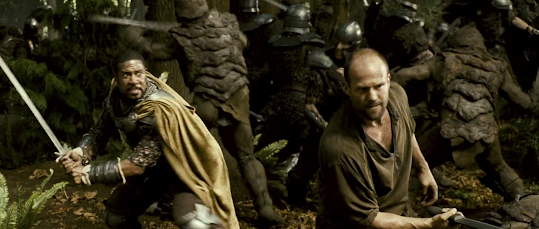
 Meanwhile Jason Statham runs a farm, because he's Farmer, you see. He's got an idyllic life with a lovely wife (Claire Forlani) and a son, and is best buds with Ron Perlman. So of course that means the LTOs strike, kill the kid, abduct the wife, and set Farmer off on a collision course with the evil wizard controlling them (incidentally, the effects when he controls them look almost exactly like a low-rent version of when anyone puts on the true ring in the Lord of the Ring movies).
 There was an earlier version of the script that had to be scrapped and rewritten (by Doug Taylor) because it was too similar to Lord of the Rings; the final version still extensively... ahem, 'homages' those movies, visually, aurally and plot-wise.

 Anyhow. At the same time Farmer goes off on a rampage, the King (Burt Reynolds, who like Sobieski can't be arsed to act), the good wizard (who's all-in because of he is John Rhys-Davies and John Rhys-Davies never half-arses anything) are trying to figure out who's behind the invasion They're passively opposed by the king's nephew, a petulant, perpetually drunk nee'r-do-well played y Mathew Lillard, who at least seems to be having fun trying on an English accent. He's in cahoots with the evil wizard, of course.

 There's quite a few fights, with some interesting twists. The action is quite a bit more martial artsy than other fantasy movies, owing to the pedigree behind it. Statham actually does all right by it, with a lot of kicks and tumbling about, though the shooting style lets it down by featuring a lot of cuts and constant camera movement. I've seen some behind-the-scenes style shots of some of these scenes and they actually look much better than the end product; In them you can see the actual film camera whizzing by, on rails.

 There's some silly stuff as well which seems like it would be right at home in a Chinese movie, so I do wonder how much influence Ching Siu Tung had on them. There's honest-to-god ninjas that join a general melee at one point, that's fun (I think they're meant to be elves). There's a surprising amount of heightened tree climbing and brachiation, including Kristanna Locken in a leather push-up bra and friends swinging down from the treetops in magical vines. Also, the LTOs build a giant slingshot to launch themselves into battle. The final fight against sexy evil wizard Liotta has some cool moves and poses, possibly the place where you can most see the action coordinator's influence.

The effects are mostly poor, the designs tend to ape Lord of the Rings... poorly, and the dialog is terrible - so many scenes consist of people talking nonsense at each other, stuff that sounds vaguely ominous or cool-sounding but doesn't actually mean anything. And the music, when it's not trying to mimic Howard Shore, often poorly fits the scenes it's scoring. This is especially galling as the games had some truly excellent, very memorable music; I wonder if they needed to pay extra to get it?
 Stay through the credits for not one but two Blind Guardian songs, plus one by Hammerfall. None of them written for the movie, and neither of the Guardian songs are as good as the one they wrote for an actual videogame.

 It completely fails as a fantasy movie mostly because despite an abundance of pretty nice-looking locales and sets, there's next to no sense of it being a coherent world, just a jumble of elements and places, many of them pretty derivative. Few of the actors even try to put on an accent, any accent, and I seriously doubt anyone thought about trying to coordinate them in any way.

 As a game adaptation... meh. It does follow the events of the first Dungeon Siege game, somewhat: the LTO attacks, a broken bridge, the evil and good wizards, etc. I'm not even going to pretend to care that they did the story wrong or whatever, since the first two games were extremely poorly written, all po-faced fantasy filler. I mean, the kingdom is called Ehb! That's how much effort the original game writers put into it. The third Dungeon Siege game was handed out to another company and actually had an excellent story, but that came out years after the movie got made.

Dude, where's your armor?

 The main crime it commits against the games (and common sense) is kind of hilarious, conceptually: The protagonist keeps his farmer's simple shirt and breeches for the whole movie, even when he goes to war. Because he's Farmer, dontcha know, a simple guy, guv.
 The Dungeon Siege games are an offshoot of Diablo, and all about collecting and equipping incrementally better loot; So if the adaptation was serious about doing the game justice, it'd have Statham wearing incrementally more elaborate costumes, until by the end he'd have spikes all over, a dozen-meter-long cloak and police lights on his shoulders.
 It's also pretty funny (and so, so stupid) that the guy doesn't get out of the same peasant's outfit throughout the whole movie, even when he finds out that he's the crown prince (spoiler!). Success don't change him none. It's thematic!

 To be honest, I wouldn't say this is a trainwreck or anything; If I had to compare it to something, I'd say it's most similar to shitty TV fantasy shows like that horrible Earthsea adaptation the Sci Fi channel did back in the oughts - and this is easily better than that. It's just kind of bad, and mostly boring. Weirdly inert and so, so bloated - asking us to give two shits about side characters that we couldn't even muster a half-hearted fart for. Though that's probably my fault for getting the 30-minutes-longer director's cut.

 Maybe I'll get around to the sequel someday, which at least is only ninety minutes... but this has kind of killed my enthusiasm for it.

Tuesday, February 27, 2024

Dune: Part One

  There's a scene close to the beginning of Denis Villeneuve's interpretation of Dune that's probably made the hearts of sci-fi nerds of a certain age and over skip a beat.

All it's missing is a Jim Burns signature along the bottom.

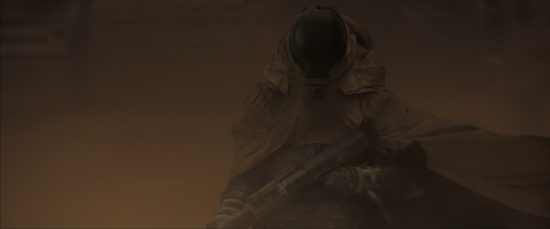
 This comes after a glimpse of a strikingly armored sci fi guard, and accompanies a an equally lyrical description of the planet Arrakis and its struggles. I am, Villeneuve is saying, one of you guys. He probably is: even if you don't take his results at face value, he'd been talking about this as a passion project from a long time back, and you just know he had to fight to get people to finance it.

 This adaptation is a staggering achievement - a faithful reconstruction of a novel that was long considered impossible to bring to the screen (I'm actually OK with David Lynch's attempt, but it just reinforced that image). James Herbert's 1965 novel is dense with ideas, a soft science fiction epic that focuses on society, politics and religion with remarkable originality and complexity. It's weirdly paced, truly bizarre (admittedly, it gets weirder on the sequels), and features loads of info-dumps and internal dialog.
 Given all of this, it's no wonder that Lynch failed - what surprises me is how close he got to succeeding, behind-the-scenes drama and all. And now comes Villeneuve, and makes a movie that not only towers over Lynch's effort, it's also much more faithful to the source material.
 It's crazy that this isn't even Villeneuve's best sci-fi film.

 The story concerns the machinations of an empire eight millennia into the future, when humanity has spread into the stars, carrying its cultures and religions to all sorts of different worlds. The planet Dune, properly called Arrakis, is vital to the empire as it is the sole source of Spice, a sort of space dope that starship pilots can use to properly chart courses among the stars. At the beginning of the story, the emperor changes the noble family in charge of exploiting the planet - from the dastardly Harkonnens to the noble house Atreides.
 (And anyone who knows a little Greek mythology will groan at that name; They might as well fly to dune on a ship called Icarus, and call their first colony Roanoke).

 There's other players in the drama: There's the Fremen, native (well, you know what I mean) to Arrakis and in a state of almost constant insurrection, and the Bene Geserit, an all-female illuminati-style order with mystical powers. The film first centers on the attempts of House Atreides to peacefully consolidate their position in the planet, and then on what happens when some pretty non-peaceful Harkonnens come knocking... and the fallout from their invasion. There's a 'chosen' one narrative where the heir to House Atreides is at the center of an ancient prophecy, but just like in the book it's clear that the prophecy has been carefully seeded to manipulate events from the shadows.

 It's a busy, busy film, one that expects you to learn all sorts of funky terminology, keep track of multiple threads, and take a bunch of weird concepts in stride. The way Villeneuve manages it is by splitting the novel into two halves, of which this is the first one. It was a risky maneuver - what would have happened if the first movie didn't find an audience? - But one that thankfully paid off. The extra breathing room allows Villeneuve and his co-writers (Eric Roth and Jon Spaihts) to lavish the planet and far future societies with attention, and a whole lot of talented people spent untold amounts of money bringing Herbert's word to the screen as organically as possible.

Seriously, that introduction...

 The effects and artistic vision are amazing, and the production design - wardrobe, vehicles, buildings - is top-notch, intricately detailed and with an impressive sense of scale. Action-wise it's good; The surprisingly prevalent hand-to-hand fights are just OK (and they sure make a whole lot of noise about those shields for them to matter very little in the end), but I haven't seen any other movie where lasers seem so fucking dangerous as they do here, and there are a lot of extremely cool-looking explosions. Everything looks, as you'd expect from this particular director, absolutely incredible.

 The acting is all shades of great, with strong central performances from Oscar Isaac, Timothée Chalamet and Rebecca Ferguson, and excellent turns by names like Josh Brolin, Stellan Skarsgård, Dave Bautista, Javier Bardem, and Jason Momoa.

 As good as it is, the film does stumble in a few areas. I'm not a fan of the sound mix - Hans Zimmer's (excellent but bombastic) score overpowers everything else, leaving some of the action weirdly low-impact. The script also struggles finding a cutoff point; The movie has a clear ending, but it plows through it and continues for yet another hour, leaving the events of this last third feeling inconsequential, despite being well-integrated into the story. The film's climactic confrontation, for example, is based on someone's unwillingness to kill - which might well be very relatable, but as a concern it comes out of nowhere, so the stakes aren't too compelling. Especially with everything that went on before.

 And a little too much is made of the mystical visions, which don't really pay off meaningfully.

 Yet. I suspect that these last two issues will become a moot point once the movie is completed with Part Deux. After all, as someone cheekily says as the last line in the movie: this is only the beginning.

 I'm just hoping they succeed... just to see how the hell they adapt Dune Messiah, which is a properly freaky (and pretty boring) book. 

Sunday, February 25, 2024

Ghosts of War

 OK, let me pull up a chair for this one, it's a lively one.

 Five airborne troopers are tasked to guard a French chateau at the very tail end of world war 2. The group consists of a bunch of walking war movie clichés: The intellectual (Skylar Astin), the all-American brash idiot (Alan Ritchson), the idealistic leader (Brenton Thwaites) and another one (Theo Rossi). The most interesting one is Kyle Gallner as a sort of sadistic space cadet; He's a lot of fun.

 The war movie aspects are mostly well done for a B-movie like this - a pulpy encounter with a nazi jeep on the way to the chateau is a good one, and later there's a defense of the house where the gang gets some unexpected assistance from... gh-gh-gh-ghosts.

 Ghosts of War is firmly on the tacky, gleefully cheesy side of horror. Think the shittier Blumhouse stuff - or even the production logo they put before their movies: Lots of jump scares, with the spirits basically lining up to pose all spooky-like for the camera.
 Here's an example: One of the soldiers is sweeping the manor grounds with his sniper scope, looking for nazis. He passes by a few statues on plinths quickly, except that last one was a creepy zombie statue? When he turns the scope back to double-check, the plinth is empty - And then the creepy zombie statue puts his zombie face right in front of the scope to growl at the soldier. Tell me that doesn't sound like something out of Scooby-Doo or Looney Tunes.

What's up, doc?

 I'm not saying I'm against it- this sort of thing can be enjoyable, and it's well made enough to be entertaining. Just... don't expect it to actually be good.
 So spooky stuff starts happening almost immediately as the soldiers are haunted by the family that previously occupied the manor, all of whom, Brainy GI quickly determines, were killed in some sort of nazi ritual (obligatory reference to the nazi higher-ups being a bunch of occult nutjobs).

 Things come to a head when the nazis mount an attack to retake the chateau, and, as mentioned earlier, the ghosts step in to get a piece of fascist-killing action. In the aftermath the sense that things are truly off mounts, and not just because of the haunting - Incident at Owl Bridge gets brought up preemptively, characters behave erratically, someone screams "THINGS ARE NOT WHAT THEY SEEM!" repeatedly.
 It turns out things are indeed not what they seem, leading to a late-movie twist that's incredibly dumb, poorly handled, and batshit fucking insane.

 Writer/director Eric Bress, bless him, seems truly proud of his Shyamalan-esque turn, and commits to it with a passion. There's a very, very poorly written and poorly staged scene showing the why the of the ghosts, Billy Zane (who also has a producer credit) pops up to drop a ream or two of exposition, and the script then proceeds to gleefully point out all the ways that it had foreshadowed the twist throughout the movie. It's all so bad it's inspired, and I couldn't stop laughing.

 It could have worked... maybe, but the heightened spookablast, B-movie tone was never going to carry it.  I guess it's one of those things where they had to try it but it didn't gel. The end result is a pretty bad (but entertainingly so) haunted house yarn going off the deep end in a howlingly funny fashion; I loved it for all the wrong reasons.


 Obligatory apparition of a haunted toy: A piece of string, I guess: it's a game of cat's cradle. Honestly, it's the best part of the movie - part of a tale that's revisited and it keeps getting creepier every time it's told, the one horror element that is truly effective in the movie. It even gets an appropriately over-the-top origin story in the film's ridiculous twist.

Saturday, February 24, 2024

Into the Abyss (Me encontrarás en lo profundo del abismo)

 Into the Abyss, or to use its original, more evocative title: You Will Find Me in the Depths of the Abyss, is an interesting no-budget Argentine science fiction/horror hybrid set in a post-alien invasion Buenos Aires where a few survivors scrabble around abandoned buildings under an eternal storm.


 Its best bit of world building comes near the beginning when we catch up with our protagonist, Bannon (Martín Rispau), locked in a car under the driving rain. He finds an almost-empty plastic water bottle, shakes it wistfully, and drinks the dregs desperately; We'll find out what's wrong with the rainwater soon enough (let's just say it owes a little to Oesterheld and Solano Lopez's El Eternauta), but it was beautifully set up by this small gesture. Bannon looks through some pictures of his wife and son on his phone, listens to her voicemails, and finally (we assume) hunger and thirst compel him to abandon the vehicle and go into a nearby building.

 The place is derelict and picked clean by looters, but he soon finds a dead body with a gun and a walkie talkie. Trying out a frequency he finds written on a wall, he manages to make contact with Demian (Germán Baudino), who keeps him company as a disembodied voice. Later Bannon has to escape from some sort of monster and has a face-off with another survivor.
 There's a very heavy survival horror videogame vibe to all of these elements - director Matías Xavier Rispau is a self-described gamer, and is currently working on a videogame set in the movie's universe. As a movie it works, just about: the pacing is glacial, and while there's enough atmosphere to get by on that alone, it feels a little too familiar to anyone with passing familiarity with modern computer games. 
 The script (by Rispau and Boris C.Q.) peppers Bannon's journey with incidents, some unexplained weirdness and a little action, but seems to get tired of the abandoned city a little past the halfway mark and changes locale and feel to recontextualize everything we know about the protagonist. I can't say I didn't welcome the change - the survival horror first half was severely overstaying its welcome, and I like where it ends up leading. But it leaves the film feeling fractured, two separate pieces that don't really mesh well together.

 Flawed and a little boring, but interesting - and given that it was made for something like a grand and a half in US dollars, its shortcomings are easy to overlook. The visuals (cinematography by the director and Juan Facundo Lopez) often manage to look lovely, in a very bleak way, although the digital video doesn't play nice with the often very dark environments. The acting's fine - Martín Rispau makes for a believable, slightly unhinged survivor, and Baudino is excellent as Demian.
 But it's the score by Martin Fuu that knocks it out of the park, often elevating the film with a wonderful synthwave score I am currently streaming in the background - it takes a while to get going, but once it does it's good enough to listen on its own. His soundtracks for Legiones and When Evil Lurks were excellent, but this one is something else.

Friday, February 23, 2024

Four Lions

 Chris Morris is probably best known to the world as Denholm Reynholm, the high-intensity CEO in The IT Crowd's first season, before he was killed off and replaced by national treasure (treasurr-eh!) Matt Berry. But at least in the UK, Morris came to (semi-)popularity as the main driving force behind a show called Brass Eye, a fake news show full of (then) current-events satire and absurdist humor. Do seek it out, it's great.

 The show had a habit of lampooning moral outrage and media-fuelled panic. However, it ended in 2001... so it never got to do a show about terrorism.
 Morris corrected that nearly a decade later by writing and directing Four Lions, a film about incompetent would-be Jihadists based out of  Sheffield dead set on blowing up... something, they can't agree what. It's an absolutely pitch-black comedy; Despite leavening it with a ton of absurdism and very silly humor, almost fifteen years on there are few blacker.

Tiny Nandor!

 The four lions are: Omar (Riz Ahmed), the idealist straight man of the group, whose loving family supports his suicide bomber aspirations - he talks about it with his wife (Preeya Kalidas) as if he were discussing the possibility of  a promotion at work. Waj (Kayvan Novak) describes himself as thick as fudge, and yes, he absolutely is. A total sweetheart, though. Barry (Nigel Lindsay), an all-British muslim who's the most volatile (pun not intended) and gung-ho of the group. Faisal (Adeel Akhtar), a quiet, shy idiot who's convinced he can train crows to become flying bombs. And finally Hassan (Arsher Ali), a young convert who joins the cell during the movie - he's the young eager padawan.
 Yes, I know that's five - one of the lions suffers from premature detonation before the grand finale.

 Their journey includes a trip to contact Al-Qaeda in Pakistan (where the immortal words 'floppy camel sphincter' are uttered in rage), a whole lot of planning and bomb manufacture, a shitload of bickering, and the eventual climactic terrorist attack.
 There's a pervasive sense of doom to the whole arc, which ends up turning Waj, a deeply cartoony creation, into an almost tragic figure. Not bad for a character who keeps comparing the afterlife to rubber dinghy rapids; The poor, sweet idiot.
 It cleaves to the Brass Eye ethos in that everyone is a moron - the authorities, when they do respond, manage to fuck things up almost as spectacularly as our heroes.

 The film remains as bracing, timely and unique as when it came out. In a world that's on its twenty-sixth South Park season, I'm always disappointed to find out how little-remembered this movie is; I'd hesitate to even say it's reached cult status.
 If nothing else, it's a trove of great quotes, funny jokes and running gags, brilliant turns of phrase, and ridiculous, hilarious conceits, all served with a still sharp edge and some affection for its characters. That should ensure it a better legacy than most of the Judd Apatow-influenced shit that was rampant at the time.

Thursday, February 22, 2024

Pootie Tang

 Spinoffs from sketch shows tend to be weird - and holy crap is this one a particularly weird confirmation of that rule. Mostly in a good way.

 The character Pootie Tang (Lance Crowther) originally appeared as a guest interviewee on the Chris Rock Show, a successful musician whose every other word is some silly-sounding made-up slang, but who's perfectly understood by everyone around him. The film is that amped up to eleven, plus a pretty funny origin story, a super-hero arc, and a buttload of ridiculous characters.

 Pootie is one of those Blaxploitation figures who's impossibly cool and competent: A world-class musician, consummate ladies man and crime fighter, but also a clean-cut Mister-T-style hero to kids everywhere. Trouble starts when he does a PSA commercial telling kids to be healthy; It's so popular it earns the wrath of Dick Lecter (Robert Vaughn), head of Corporate America - which markets to kids such products as cereals, fast-food burgers, crack, switchblades and rat poison... sales of which go down by as much as 20% immediately after the PSA airs.
 Dick sends his main squeeze Ireenie (Jennifer Coolidge) to seduce Pootie into selling his persona to Corporate America and to steal his belt, the source of his powers. She succeeds, and Pootie falls from grace until he gets his mojo back.

 As it usually goes in these type of movies, the plot is only an afterthought threaded in between ridiculous, story-free bits like a gloriously silly action scene where Pootie interrupts some criminals from tricking a dumb kid (the dumbest, the narration tells us) into trying their drugs. One of the villains in that scene - Dirty Dee (Reg E. Cathey) - is so literally dirty he trails a dust cloud like Pigpen from Peanuts, and Pootie bats away his bullets with the end of his pony tail. The movie constantly cuts away to have other characters comment on the action, particularly Pootie's friend Trucky (J.B. Smoove) and would-be-girlfriend Biggie Shorty (Wanda Sykes), who's often shown dancing with huge headphones on like the cheesiest, most cringe-worthy MTV interstitial ever.
 Speaking of MTV, a lot of the filmmaking takes its cues from then-current shoddy rap video filming tricks and MTV 'coolness', including very cheap-looking speed ramping and clipping. Zack Snyder has frequently gone on record to state that his style, as solidified on 300, was heavily influenced by Pootie Tang*.

 Chris Rock produces and plays multiple roles, and of course there's a ton of cameos from MTV and HBO people who were big at the time or would be soon afterward (Dave Atell, Missy Elliot, a teeny-tiny Kristen Bell, Jon Glaser and a lot more).

 I should probably mention this is written and directed by Louis C.K. (then a writer on the Chris Rock show), who's had a pretty public fall from grace since, and includes a bunch of instances of blackface - I wouldn't think that'd be a problem, since it's used here as a dick move by corporate stooges (including David Cross) to impersonate Pootie, but I'm not that clued up on this sort of thing.

 Even at eighty minutes it threatens to overstay its welcome - there's a lot of padding and stuff that just doesn't work. But a likeable tone, a surreal anything-goes sensibility and a buttload of goofy jokes carry it through; No one would ever confuse it with a good (or a non-deeply stupid) movie, but it's bright, chipper, and silly fun.


*: I've shown this sentence to world-class Snyder historians who have said it's amazing. They can't believe it's as accurate as it is.

Wednesday, February 21, 2024

Woman in the Chair

 Faced with incontrovertible proof of the afterworld, it figures that an influencer would choose to make it a roadside attraction.

 I'm being more than a bit glib here; Maurice (Hagen Vanholland) is not really an influencer, more one of those youtube paranormal investigators. And he doesn't immediately go out to exploit the ghost he finds sitting, immobile, in a creepy abandoned and inaccessible house in Japan. 
 The way things work out, Pearl (Shoko Plambeck), a fan of his youtube videos, hooks him up with her fiancé Devon (Evan de Sousa) - a kind of sleazy rich Frenchman who's hosting investment pitches at a party attended by some presumably rich people. Mostly fellow expats.
 
 Maurice, realizing how big his discovery is, has sat on the video instead of putting it up on his channel, and agrees to pitch it in the meeting to try to secure funds for a proper paranormal investigation. The pitch does not go well, but later in the reception, a couple approaches him asking him if they could see the ghost; You can almost see the dollar signs appear in Devon's eyes.

 Soon they organize an expedition out to the house - which lies in an island in the middle of a lagoon formed by a semi-recent typhoon - and find that yes, the ghost is still just sitting there, in her run-down room.
 So they hire a couple of expat handimen (A.J. Hamilton and Kai Issey) to put a transparent acrylic wall so they can bring tourists over to see the ghost. One of the handymen gets attacked by the ghost when left alone with her, the other one ends up muscling in on the operation as a security guard.


 Business goes all right at the beginning, even though a rich asshole (Charles Glover) forces his way into the ghost's room to get a closer look - instead, he goes into a short trance, and then forgets whatever it is that happened.
  The movie posits Devon as the bad guy, constantly making the worst decisions and pushing for them, but neither Maurice nor Pearl are off the hook as they don't protest nearly as much as they should. Devon is also put on the wrong end of a sort of a love triangle (chaste on all vertices) that develops between himself, Maurice and Pearl; Again, it tries to paint Devon as, if not the villain, as clearly in the wrong in the relationship, but it seems to me that it's Pearl at fault, as she's effectively stringing him on for his money. To be fair, it's slightly more nuanced than that, and there's exactly zero chemistry between Devon and Pearl. But it still rings off - it's natural for the guy to want to fool around a little with his fiancé, and it's not even like he's too pushy or anything, but here it's treated as a huge betrayal - ends up making the film's tone seem pretty prudish.
 Not to defend Devon, who seems like a douche, but let's not clear the others of any blame.

 Anyhow. It's all pretty entertaining! The premise is great and well developed, barring some bum notes and obvious points that even a dipshit like Devon should realize (like the fact that they're building a place of business at a house they don't own, something a local policeman has to point out later; did any of them even think of it?), and it's fun to see how these dumbasses dig a hole for themselves.
 Until a reporter gets wind of the phenomenon and goes in to try and make contact with the ghost, and the script loses it completely just in time for the third act. Actually, it at first it only mildly loses it - sure, the reporter doing something insanely stupid while none of the others realize it because their (non-)sexual tension has reached a breaking point; it's the first time the movie lets the ghost go wild with her telekinetic powers, and she gets in some pretty respectable zero-budget mayhem.

 It's after the fallout from that settles, when everyone gets taken to the local police station, that things really go to hell. Some characters return to the house, joined by other characters from earlier in the movie for poorly explained reasons. All sorts of crazy revelations come tumbling out, all of them completely unforeshadowed, and.. well, pretty fucking dumb. A whole room in the house with an important element is introduced at the last minute, Pearl sees a picture and immediately comes up with some pretty out-there explanations, all sorts of (awkward, low-budget) confrontations take place, and the movie ends up going out with an unconvincing whimper.
 I mean... it's not not fun, and there are some cool images in the mix- a highlight, spoiled in the trailer, has a walking man keel over only for his invisible ghost to leave footprints in the mud where his path would have continued. But it's a shame to see a pretty sharp script (by director Derek Hammer) devolve into this sort of complete bullshit.

 A shame. But two thirds of a good movie, especially a good, well-shot, mostly well-written and paced movie produced on what seems like the low end of a regional production budget - that's nothing to sniff at. I liked it, despite the completely botched final act.

Monday, February 19, 2024

Black '47

  Irish soldier Martin Feeney (James Frecheville) returns to his native Connemara from a long foreign stint with the British military to find his land in shambles. It's 1847, the great hunger has been ravaging the land for two years, and the English landowners have been using the widespread poverty as an excuse to evict famers from their holdings, causing deaths from exposure to skyrocket as the malnourished, bankrupt peasants are turned loose on the countryside.

 His mother and brother dead (she died of starvation, refusing to take the Anglican church's charity as it came on condition of conversion; His brother was hanged after stabbing a constable when their house was taken), Feeney aims to take his brother's remaining family and join the hordes of Irish folk fleeing to America.
 Unfortunately, he never gets the chance: One bright winter morning the local constabulary arrive with an order to tear the roof from his brother's house and evict everyone inside. Martin is held down when he tries to intervene, and can only watch as someone is shot while resisting and the women are turned out into the frozen wilds barefoot.
 When he returns from the constabulary the next day he finds his sister in law and her daughter frozen to death in the now roofless house.

 Pretty good basis for a revenge movie, right? Black '47 is a well-researched, very angry revenge fantasy that's not just about the particulars of its story, but the whole sad chapter in Irish and British history. An angry pointed finger at what some historians consider a deliberate attempt at genocide, courtesy of some long-dead people who still have statues up in parks and streets around London. Fun!

 And yeah, it almost is fun, because as it turns out Feeney has a particular set of skills, which he demonstrated amply the day he was taken to the constabulary in a pretty cool action scene. Killing, I mean. He's good at killing, which he does frequently during the movie, and with a grim sense of poetic justice.
 But that bit in the constabulary is the only properly exciting action sequence in the movie, because I guess the movie is sadly not insane enough to go all Django Unchained with the great famine. Oh well, at least it knows to go out with another big action setpiece.
 Instead of being all about angry Irish Rambo against the dastardly English, Black '47 focuses on a small army task force that gets sent to stop Feeney by any means. It's led by a young, pompous little shit (Freddie Fox), with constable Hannah (Hugo Weaving) as their tracker and a young private (Barry Keoghan) to tend to their horses. Hannah is very much the Col. Trautman figure, an old army buddy of Feeney's who provides running commentary on how the British picked the wrong man to push.


 So we mainly follow these three - soon to be four, with the welcome addition of a local guide played by the always soulful Stephen Rea - as they follow Feeney on his rampage, always two steps behind. It's an engaging tale, though there's quite a bit of on-the-nose exposition as the movie makes time so that the British villains can vent their loathsome practices vis à vis the famine situation. Jim Broadbent's Lord Kilmichael is all in for genocide, for example, happily comparing his work with the wiping out of the Indian nations in the US.
 Most of these stances are certainly well documented, but as asides in a genre movie they're a little too didactic. I'd probably appreciate them more if I didn't know about the points they're making already, though. Not to mention that the two-dimensional villains do make the film's premise, which is basically a slasher movie where an unstoppable murdering machine works his way up systemic injustice, much easier to swallow.
 Its desire to illustrate the ills of the time include a completely unnecessary aside into how the English were still exporting food during the famine. Again, true, and again, a bit preachy. The approach does have some problems, but its heart is int the right place and by making the oppressors into such clear bad guys it tilts the movie further into action territory, so it didn't actually bother that much.

 While it tries hard to remain on the period drama side of things, I'm comfortable calling it an action movie based on the amount of shootouts, chases and that pretty cool fight at the constabulary, and the opposition being such an unrepentant, openly evil (to our eyes) cast of villains*. Or maybe a pseudo-Western.
 The script (by P.J. Dillon, Pierce Ryan and Eugene O'Brien) has some pretty big superficial similarities to First Blood, but they remain skin deep - The Rambo here is not really a character, just a hook on which to hang a gritty revenge yarn festooned with history lessons.

 There's quite a few heavy hitters in the cast, and they all acquit themselves nicely, with (unsurprisingly) Weaving and Rea standing out. Frecheville is fine, but his character is only ever required to be stoic and convincingly badass, which he does handily.

 Director Lance Daly directs the action with some flair, and Declan Quinn's cinematography is beautiful - wintry and as drained of color as the story is drained of nuance, all miserable Irish landscapes with abandoned thatchless cottages. He also likes to shoot darkened interiors with natural light seeping in, some of the scenes resembling a sort of dutch chiaroscuro. Plenty of striking imagery here.


*: someone smarter than me would write a joke here about how the word villain comes from villeins, which are similar to the victims of this movie's villains.